Twelve Churches
Manifesta 16 hands twelve dying churches to the public and lets the art step back. That restraint is the review.
The strongest work at Manifesta 16 is not a work. It is a decision: take twelve deconsecrated or dying churches across Duisburg, Essen, Gelsenkirchen and Bochum, open them free of charge for fifteen weeks, and call the result This is not a church. Germany expects more than 20,000 of its churches to fall empty within a decade; the diocese of Essen alone will have given up most of its parish churches between 2005 and 2030. Most biennials borrow a crisis for atmosphere. This one moved into the crisis and handed over the keys. After three days in the Ruhr my conclusion is simple, and it organises everything below: the art here succeeds exactly where it proposes a use for the building, and blurs exactly where it behaves like an exhibition that happens to be in one.
The structure supports the reading. There is no single curator. The urbanist Josep Bohigas wrote the framing study after the team surveyed around 200 churches to choose the twelve, curatorial pairs cross generations (René Block, born 1942, works with Leonie Herweg, born 1997), and it is Hedwig Fijen's final edition as founding director. A biennial about handing buildings on is itself a handover in progress, and I do not think that is an accident.
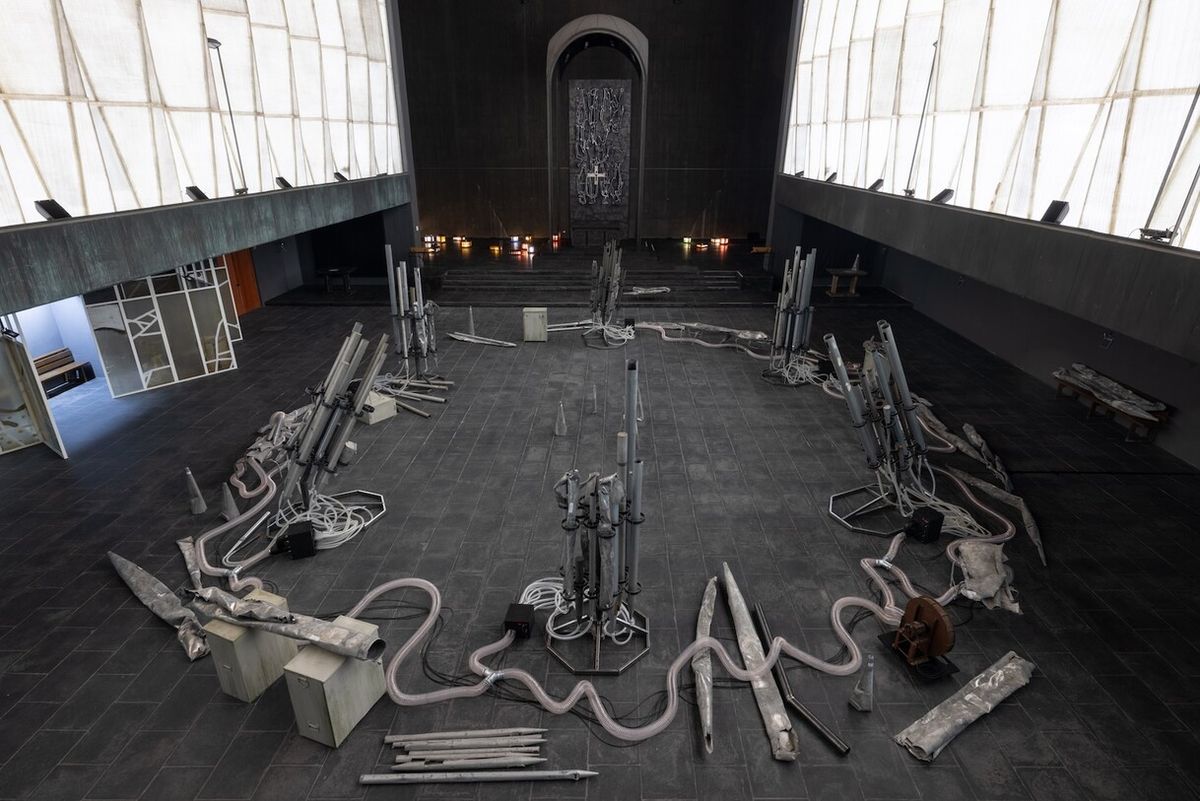
Duisburg makes the case for proposal over display. At the Kulturkirche Liebfrauen, a concrete church built by Toni Hermanns between 1958 and 1971, Abbas Zahedi has gathered orphaned organ pipes, some salvaged from the church of St Nicholas in Kyiv after its 2021 fire, and set them on stands with a pneumatic air supply. Each pipe alone looks uncomfortably like ordnance. Together they hold a low chord, a hum the building was built for. This is not a sculpture placed in a church. It is the church's own instrument, rebuilt from the instruments of dead churches, doing its old job with new lungs. Nothing else I saw all summer stated the biennial's premise so exactly. Elizabeth Price's video nearby, built from inverted archival photographs of the 1940s air raids on the Ruhr, gives the same building its memory back.
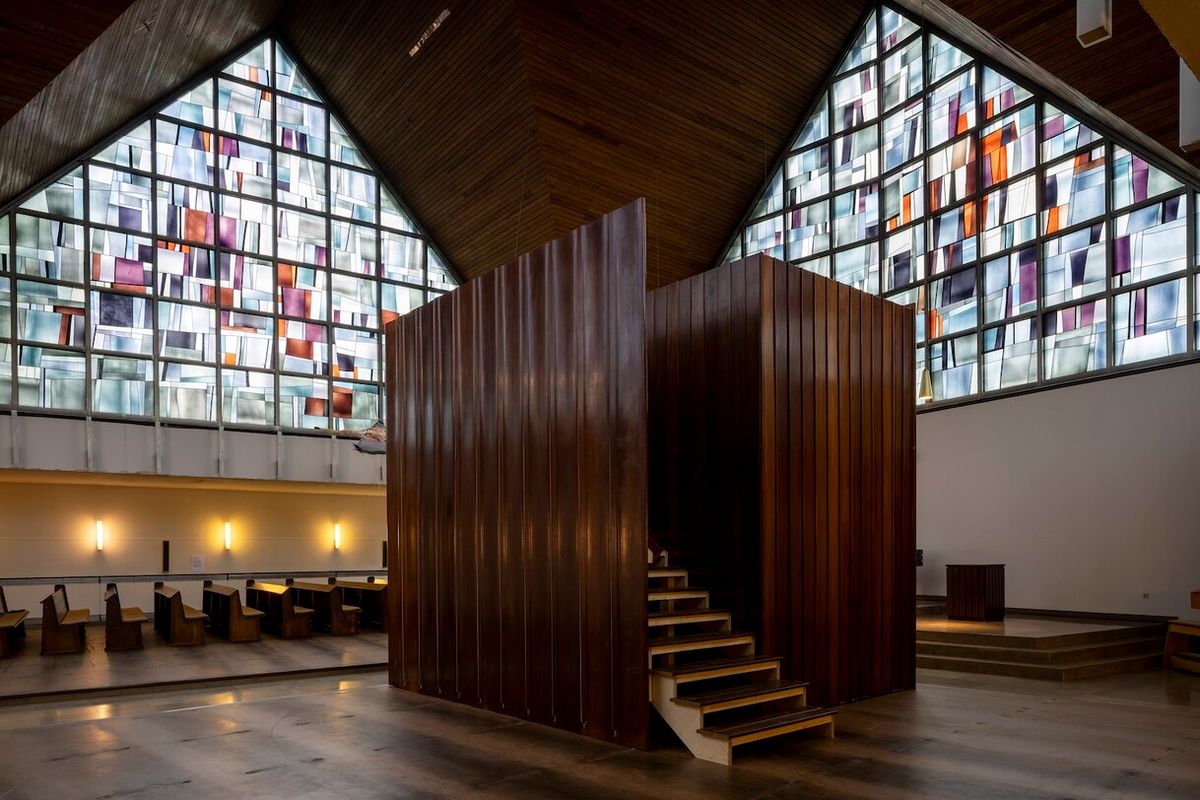
Essen shows both halves of my argument in one city. On the proposal side: at the Markuskirche, Augustas Serapinas has rebuilt the pews into Pew Tower, a climbable cube nearly five metres tall, the furniture of obedience turned into a structure you scramble up. At St. Gertrud, where the last service was held in 2025, Ayşe Erkmen's confessional asks you to confess to an AI on a screen. It had a queue. I did not join it, and the reason is the point: the booth still worked on me as a confessional, and I was unwilling to treat it as a prop. When the art activates the building's old habits, you feel it in your own behaviour. On the exhibition side: at St. Marien, a Hans Schilling church from the 1960s that stands close to demolition, William Engelen's curtain of metal tubes hangs where the organ was and sounds when you brush it, and Jason Dodge has arranged what was already in the building, sawdust and paint pots and broken wicker chairs, an inventory of last things. Both are intelligent. Both would also survive being moved to a kunsthalle, and in a project like this that is a criticism.
Gelsenkirchen is where the biennial stops being about buildings and starts being about the people the buildings were for. Gürsoy Doğtaş has renamed his three churches after people. St. Bonifatius is now the Ferdane Satır Tea Garden, for a woman killed with six members of her family in a racist arson attack in 1984, and at the altar Merve Kaplan has installed a migrant living room: carpet, tiled tabletops, house slippers, teacups. Cana Bilir-Meier revisits the 1970 competition that tried to replace the word Gastarbeiter; among the submitted alternatives was "unconditional guests." The Ruhr's churches were filled for a century by people brought in to work, and this is the one city where the biennial says so with names attached. I found it the hardest part of the show to leave.
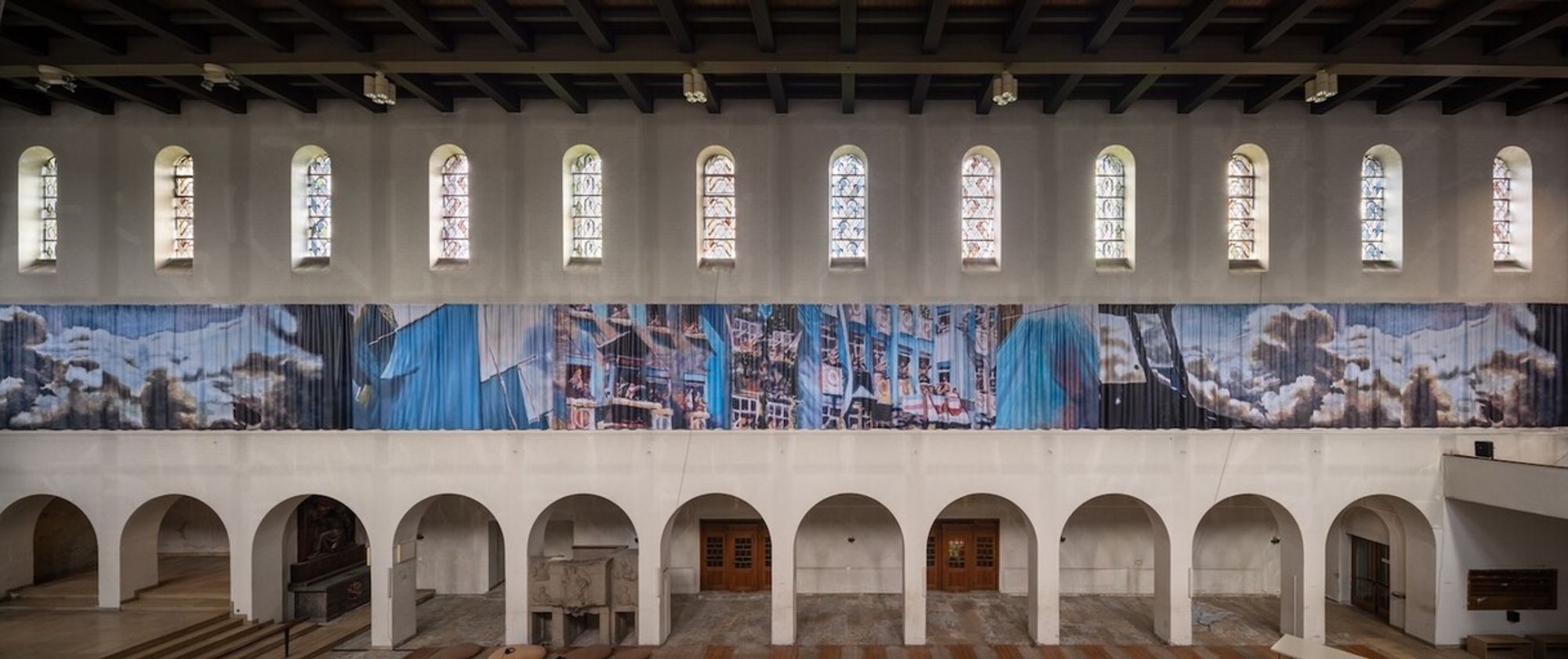
Bochum takes on the century directly, and here the exhibition mode earns its place, because the subject is images rather than use. At Christ-König, a 1932 church by Franz Schneider, Luc Tuymans has hung KINO, a printed curtain 36 metres long made from an AI-colourised print of Triumph of the Will with the swastikas removed and the flags turned blue. The nave in front of it belongs to Eva Koťátková's giant stuffed birds and worms, sleeping or injured across the floor, and the hang answers itself: the film that once organised bodies into formation now hangs over creatures that cannot get up. Outside the Gethsemane church, one of Otto Bartning's emergency churches from the years just after the war, Marina Naprushkina has parked an inflatable bouncy castle shaped like a halved bell, printed with We'll never go back! Children bounce inside a bell that cannot ring. And at St. Ludgerus in Langendreer the nave is now a basketball court with a set of strange football goals, by Bohigas with the Catalan group cabosanroque.
The catalogue leans on the Trümmerziegel, the rubble bricks the region salvaged by hand in the 1940s to build with, and for once a catalogue image matches what you see: fragments of an old world reused, not memorialised. Nobody here pretends an art biennial can staff a parish or fund a roof. What it can do is keep the doors open and let the region look at its own buildings without a service to attend. More than 95,000 visits were counted by the middle of August. That is free-entry arithmetic, neighbours included, which sounds like a caveat and is actually the verdict.
Because here is what I keep returning to. The best outcome this biennial has produced is not in any nave. The neighbourhood around St. Ludgerus has asked for the basketball court to stay when Manifesta leaves. An exhibition closed on the 4th of October cannot answer the question in its own title; a court that outlives it can. On my last afternoon, in the tea garden in Gelsenkirchen, a volunteer refilled my glass without being asked, and the building was warm and full of people who were not looking at art. This is not a church, the title insists. Correct. It is the first plausible draft of what comes after one, and the art is at its best when it knows it is the draft and not the building.