The Lower Frequencies
The loudest pre-opening in Biennale memory wrapped around the quietest show in the Arsenale. The quiet held.
The pre-opening of the 61st Venice Biennale was the loudest I have known. A strike at the gates, riot police along the Arsenale walls, a jury that had resigned before anyone saw the show. Inside all of that sits the quietest exhibition I have ever walked in the Corderie, and the surprise of the week is that the quiet is not fragile. It held. I want to describe how, because it should not have.
In Minor Keys is Koyo Kouoh's exhibition, and she is not here. She died on the 10th of May last year, at 57, a year before the public opening almost to the day. Her team finished the show she had conceived, gathering for a last week of work at RAW Material Company in Dakar, the institution she founded. So you cannot walk this show the way you walk a normal biennale, hunting for the curator's moves. The curator cannot answer. What her people built instead is a wake that refuses to perform sadness, and that refusal turns out to be a sturdier structure than any thesis wall. There are 110 participants and no sections. You are trusted to assemble the argument yourself.
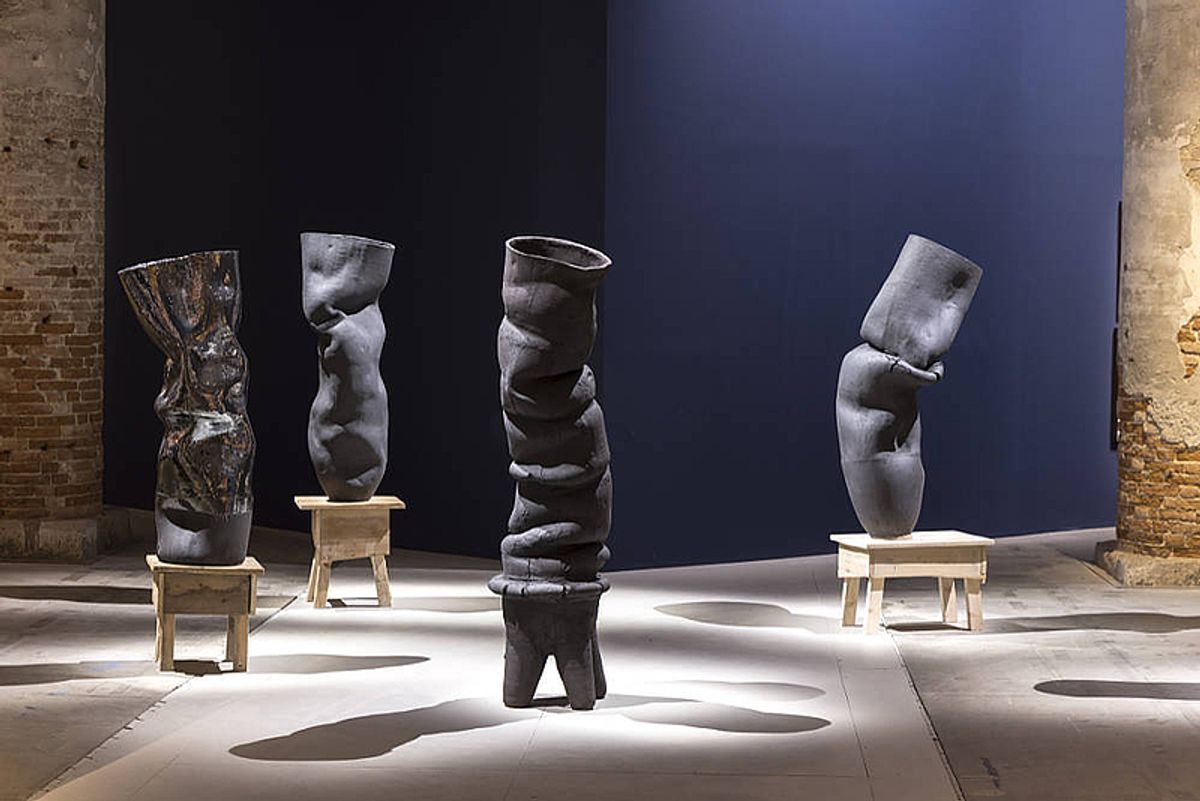
The show teaches you how to stand in it within two rooms. You enter the Corderie, 317 metres of former rope factory, under Refaat Alareer's poem "If I must die," printed on fabric and rigged like a kite beside a painted face by Issa Samb. The poem asks for a white kite with a long tail, so that a child somewhere below sees it and thinks, for a moment, that an angel has come. That is the volume set. Then the first room gives you Ranti Bam's ring of black stoneware vessels on wooden stools, unglazed and overfired on purpose, cracked where the kiln took them past safety. They sit at the height of seated people. You lower your eyes to meet them. Two rooms in, and the show has already made you bow twice.
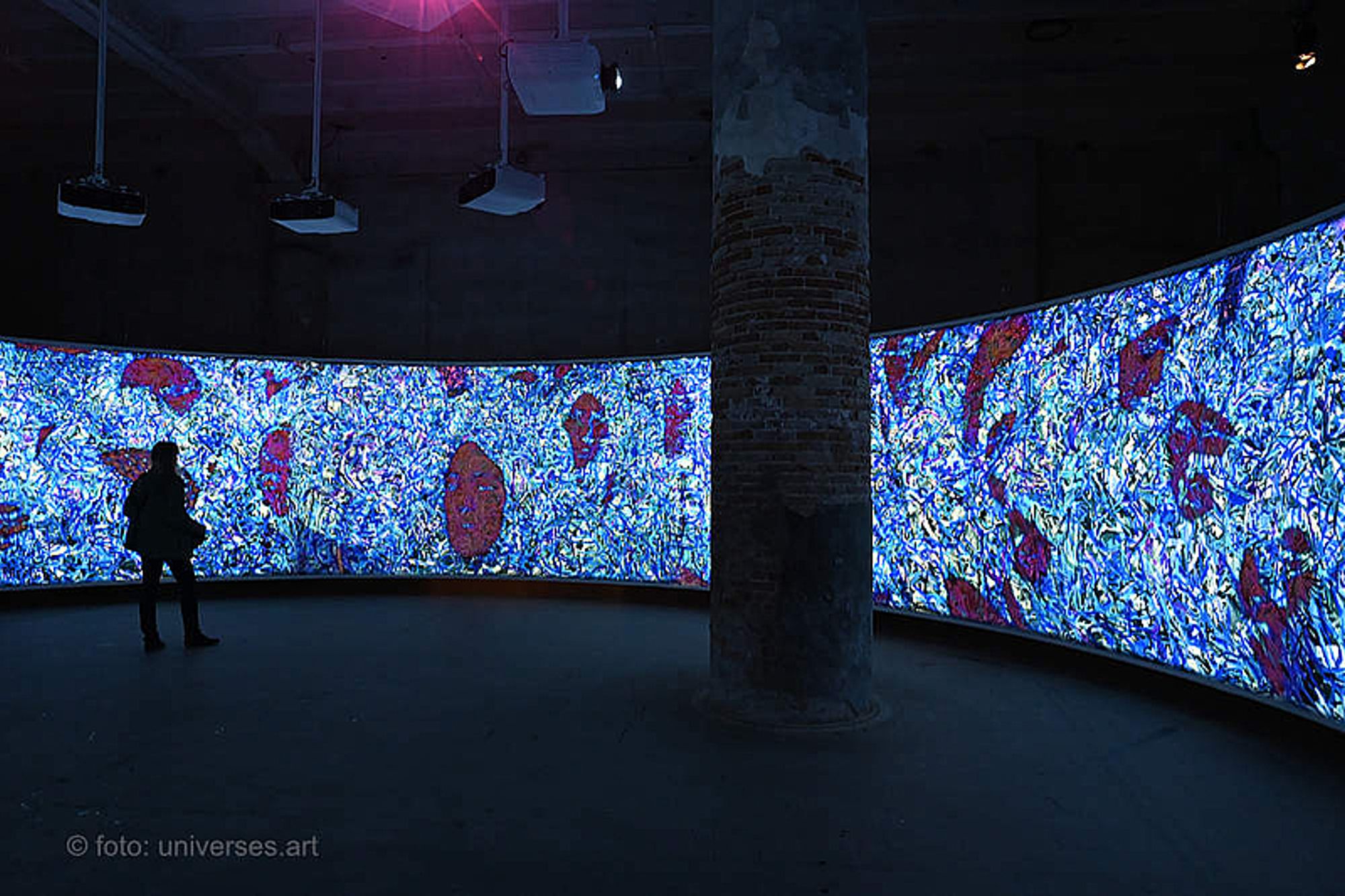
The test of a premise like this is scale, and the show passes its own test at its biggest moment. Khaled Sabsabi's khalil is a circular canvas enclosure forty metres around, eight channels of video, faces in crowds on a 64-minute loop, black oud in the air. It is the loudest thing the show does, and it is still not loud. You stand inside it the way you stand inside weather. Australia cancelled Sabsabi's pavilion commission last year, then reinstated it, and he is now in the national pavilion and the main show at once, a record with a cancellation inside it. I went into khalil twice and stayed longer than I meant to both times.
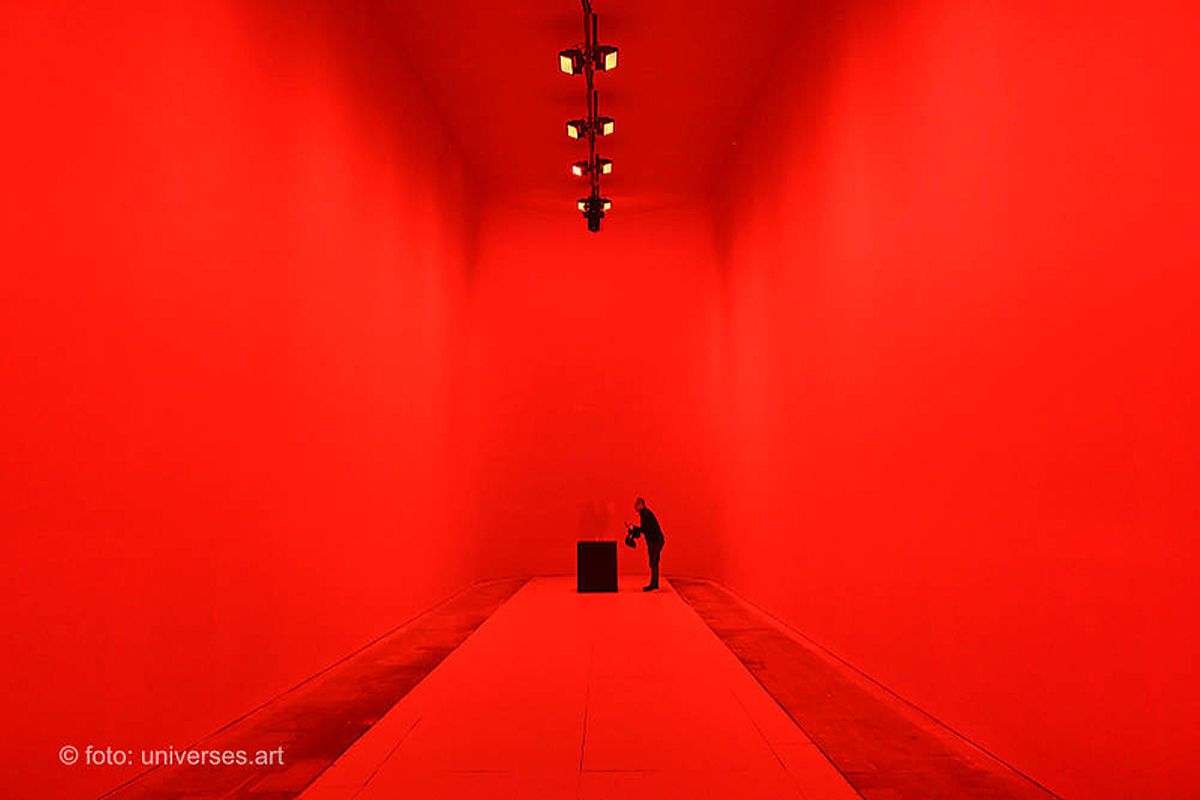
Honesty requires the other half. At this pitch, over 317 metres, some rooms blur into the indigo banners that mark the thresholds, and a press day does not carry the attention this show is asking for. I lost the thread twice and had to walk back. A show tuned this low is betting that you will slow down, and on a quiet Tuesday in October that bet will pay better than it does in the scrum of a vernissage. The works that cut through do it with smallness, not volume. Alfredo Jaar's The End of the World is a cube four centimetres on each side, pressed from cobalt, coltan, lithium and the other metals a phone needs, alone under crimson light. It is the smallest work I saw all week and the one I keep describing to people at dinner. In this show, that is what winning looks like.
The Corderie ends at the water. Fifteen scarlet heads by Alice Maher float in the Gaggiandre docks like buoys that have come loose, and Torkwase Dyson's Tougaloo closes the walk, curved slabs of graphite and acrylic with pockets of glass, named for the Black college in Mississippi. During the press days recitation moved through the halls, voices answering voices. Kouoh's text had promised "the consolations of poetry." Here they were, walking.
Now the noise. There were no awards at this opening. The jury resigned eight days out, over the question of pavilions from countries whose leaders face charges at the International Criminal Court, and the Biennale swapped its juried Lions for two prizes voted by ticket-holders in November. Dozens of main-show artists withdrew from that vote too, which reads to me as the exhibition's argument carried out by its own participants: people gathered under a minor key declining the Biennale's loudest instrument, a prize. And on the final press day, today, the Biennale had the first strike of its 131 years. Around 27 pavilions closed fully or in part. Protesters came down Via Garibaldi with Palestinian flags and met riot police at the Arsenale walls.
A show this quiet, in a week this loud, should have been drowned out. It was not, and I think the reason is that its quiet was never a style. It is mourning, practised by people who knew the person, and mourning does not compete with noise; it outlasts it. I went back into the Corderie in the late afternoon, when the press had thinned, and stood in Sabsabi's circle of faces one more time. The hum was still there. It did not cancel the noise, and the noise did not cancel it. Only one of them will still be running in November.