Only One Basel
Art Basel's 2026 edition in its home city, read through the sales, the response to Hockney's death, two structural experiments, and the large-scale work in Unlimited and on the city's squares.
This year's campaign, Only One Basel, set white type over one of Katharina Sieverding's late-1960s self-portraits, the saturated close-ups in which she turned the camera on the constructed self. An image about identity was a fitting choice for a slogan about uniqueness. With the Art Basel brand now operating in several cities, Paris among them, the question of what distinguishes the founding fair has become strategic rather than rhetorical. The edition that opened at Messe Basel in mid-June offered several answers to it.
The headline figures were those of a mature fair: 290 galleries from 43 countries, 90,000 visitors from 103 countries and more than 270 museum delegations. At the top, demand concentrated on established names. Hauser & Wirth sold Picasso's Le peintre et son modèle dans un paysage (1963), from his late cycle on the painter and his model, at its asking price of 35 million dollars. The gallery reported more than 65 million dollars in sales by the close of the first day.
The pace was measured rather than speculative. Business clustered around historically secure material, a pattern consistent with a cautious market that rewards provenance and art-historical standing over discovery.
David Hockney died in London on 11 June, aged 88, five days before the VIP opening. The works on view spanned six decades. Annely Juda's all-British presentation paired two Ubu Roi designs from 1966, made for the Royal Court Theatre, with Delphiniums on My Garden Table, July 2025, one of his last still lifes, painted the previous summer. At GRAY, Studio Interior #2 (2014), from his return to the studio as subject in Los Angeles, sold for 8.5 million dollars. Taken together, the booths formed an informal retrospective, assembled by the market rather than by an institution.
The fair tested two formats this year. Both address the same problem: how a fair holds attention when much of its business is done before the doors open.
The first, Basel Exclusive, asked around 200 galleries to keep selected works out of the presale PDFs collectors receive in advance, and to flag them in the booth with large placards instead. The measure reverses a decade in which PDFs and online viewing rooms moved the point of decision away from the stand. Karsten Greve's group of 1960s Cy Twombly paintings, from the decade of his most gestural Roman canvases, was among the withheld works and held a steady crowd all week.
The second took over Hall 1.1. Thomas Bangalter, formerly of Daft Punk, the artist Julian Charrière and the DJ Rampa built an installation that ran by day and became a rave on Saturday night, for 3,400 sold-out tickets. Its core was a sealed glass monolith in which a tape machine played Eleanor Roosevelt reading the Universal Declaration of Human Rights, placing a founding text of postwar internationalism at the centre of a dance floor. In the same edition, the Baloise Art Prize, awarded at the fair for more than two decades and known for placing winners' works in museum collections, was discontinued. The shift from an acquisition prize to an event programme says something about where fairs now look for audiences.
Unlimited, curated for the first time by Ruba Katrib of MoMA PS1, again served as the fair's platform for work too large for a booth. Bruce Nauman's Dead End Tunnel Folded into Four Arms with Common Walls (1980) belongs to the corridor works he began in the late 1960s, structures that act directly on the visitor's body: four passages narrow to a dead end, and the acoustics shift with every step. Benoît Piéron's Cairns, mounds of pastel hospital bedsheets set with ceramic eyes, continued his work on illness and care, handled with a lightness that drew laughter from visitors.
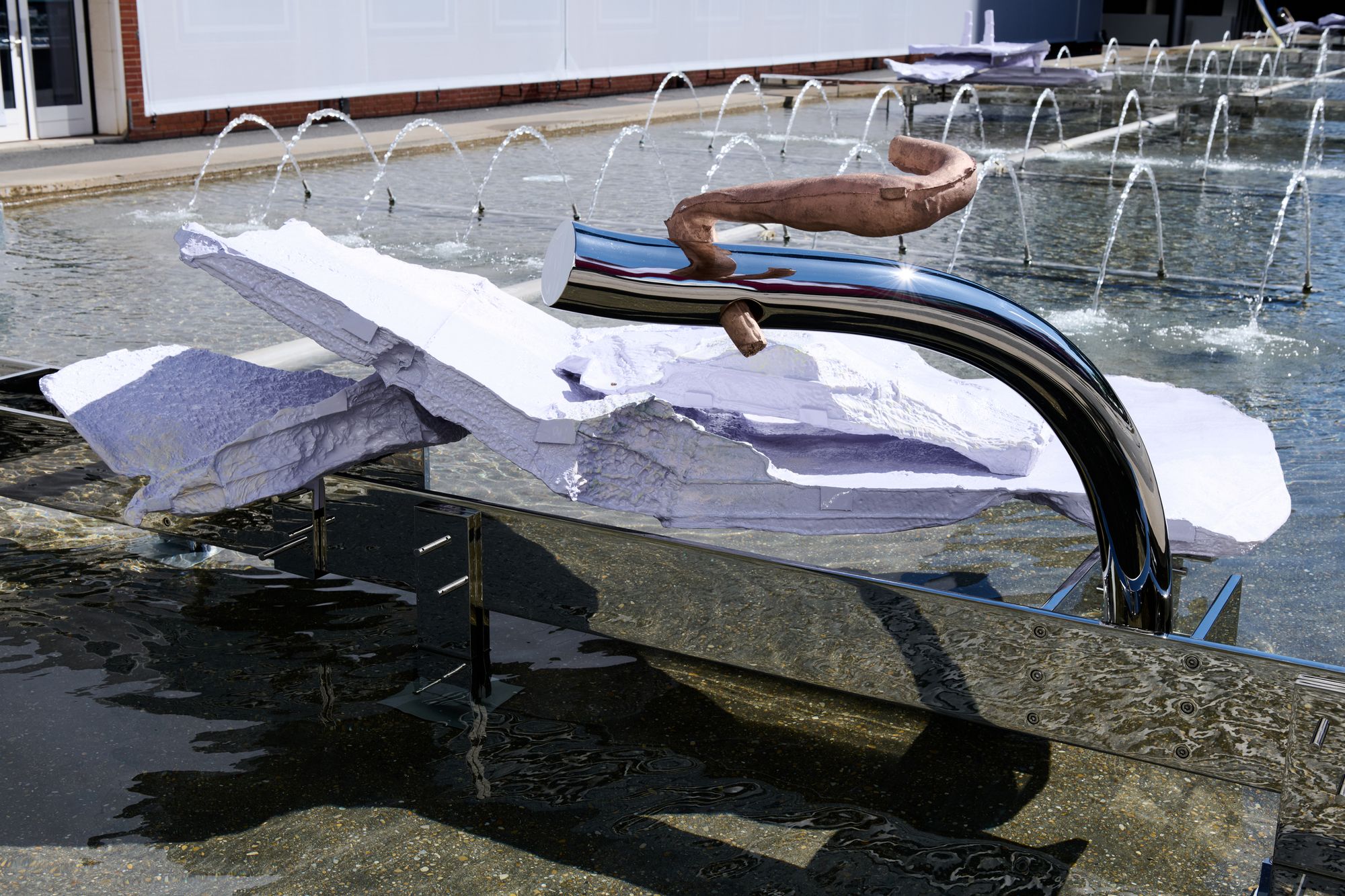
On the Messeplatz, Nairy Baghramian's Modèle vivant (S'empilant) ran the length of the fountain: pale lavender aluminium casts stacked on polished steel armatures, with a 48-metre bench alongside and the water running beneath. The piece extends her long interest in supports, display structures and the relation between sculpture and the body. On the Münsterplatz, Ibrahim Mahama suspended woven textile, tire ply and metal head pans above the square, tagged with identification labels from Ghanaian cocoa companies. As in his earlier work, materials from West African trade circuits make labour and commodity chains visible. Both installations reached passers-by as well as fair visitors.
The 2026 edition answered its own slogan on two levels. Commercially, the fair held its position: top-tier sales were quick and concentrated on historically secure names. Structurally, Basel Exclusive, the Hall 1.1 programme and the end of the Baloise Art Prize show a fair adjusting its model as the brand expands to other cities. What remains specific to Basel is Unlimited and the public programme, work whose meaning depends on scale and physical presence and cannot be transmitted by a PDF.