The Pavilion Inside a Working Prison
The Holy See invited artists to make work with the inmates of Giudecca women's prison. The inmates, in turn, became the guides.
To see the Vatican's pavilion at the 60th Biennale you had to take a vaporetto across the Giudecca channel, queue at a small unmarked door, show ID, leave your phone in a lockbox, and then wait inside a small concrete room that smelled of old paint and laundry detergent while someone went to find your guide. The guide, when she arrived, was an inmate of Giudecca Women's Prison. The pavilion was on the other side of a set of doors she had the key to.
The Holy See had done something quietly unusual this year. It had invited several artists, among them Maurizio Cattelan, Claire Fontaine, Sonia Gomes, Bintou Dembélé, Simone Fattal, Claire Tabouret and the collaborators Marco Perego and Zoe Saldana. It had set them to work not on a gallery space but on an active women's prison, with the inmates as both subjects and collaborators. The pavilion was called With My Eyes. Pope Francis visited on the 28th of April, which made him the first sitting pontiff to attend the Biennale. The Vatican being the Vatican, this was reported mostly as a scheduling fact. What was more interesting was that he had come to see a prison.
You walked in a group of six, with a guide who told you her name and then, once, where she was from. She did not say why she was there and no one asked. What she did tell you, in detail, was the work. Claire Tabouret had painted her portrait, along with about thirty others. The paintings were hung along a corridor, each inmate in the clothes she had chosen. Tabouret had come to the prison multiple times over months, sitting with each woman. The portraits did not perform tenderness. They sat there like portraits. That turned out to be enough.
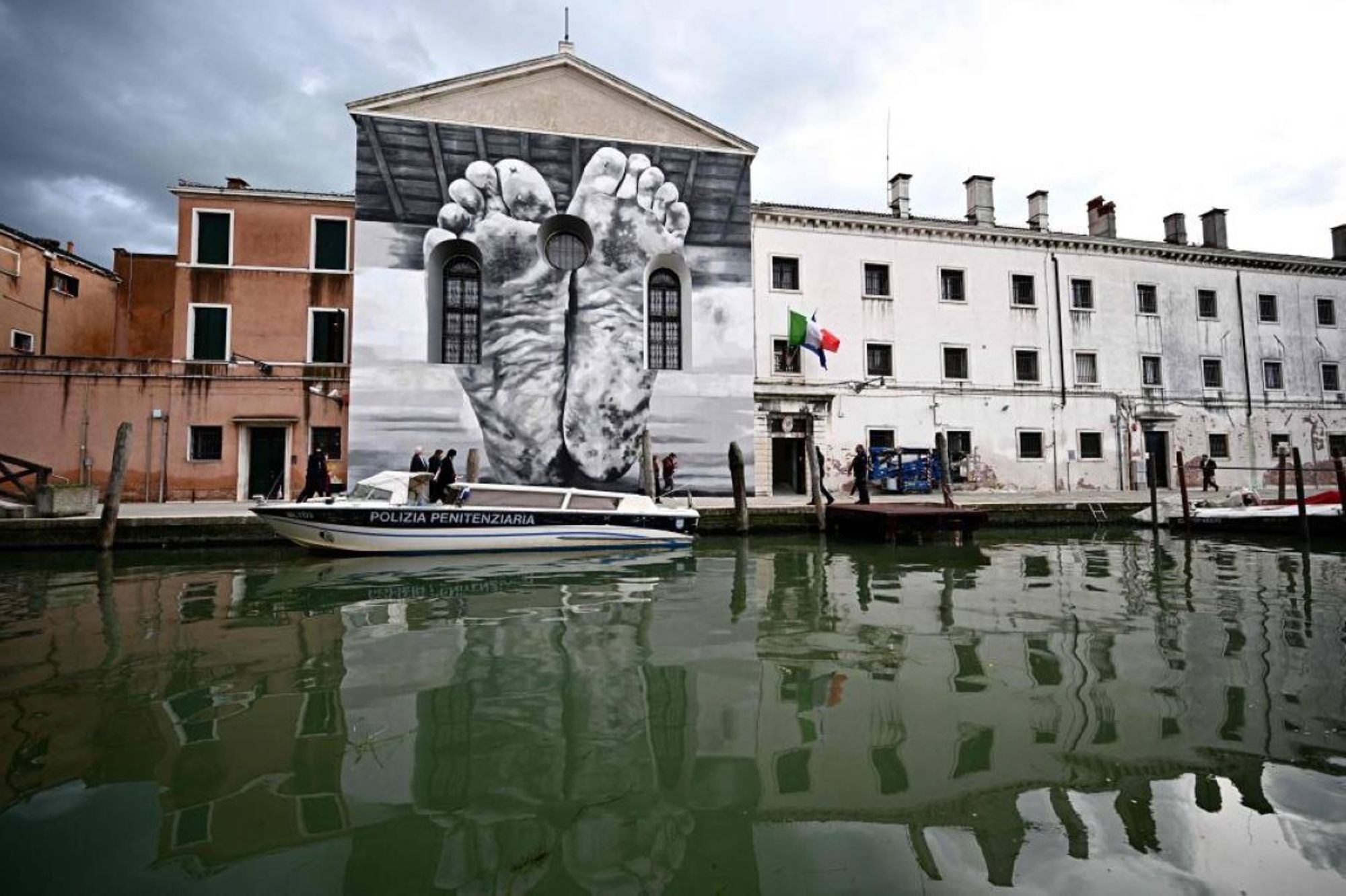
Maurizio Cattelan's contribution was mounted on the outside walls of the prison, the side the inmates do not see from inside. It was a giant mural of the soles of two feet, bare and dirty. The guide told us that Cattelan had produced a special issue of L'Osservatore Romano to accompany the pavilion, the entire issue written by inmates. She said it quickly, the way you mention something that has become normal because you have been asked about it a hundred times. Then she led us on.
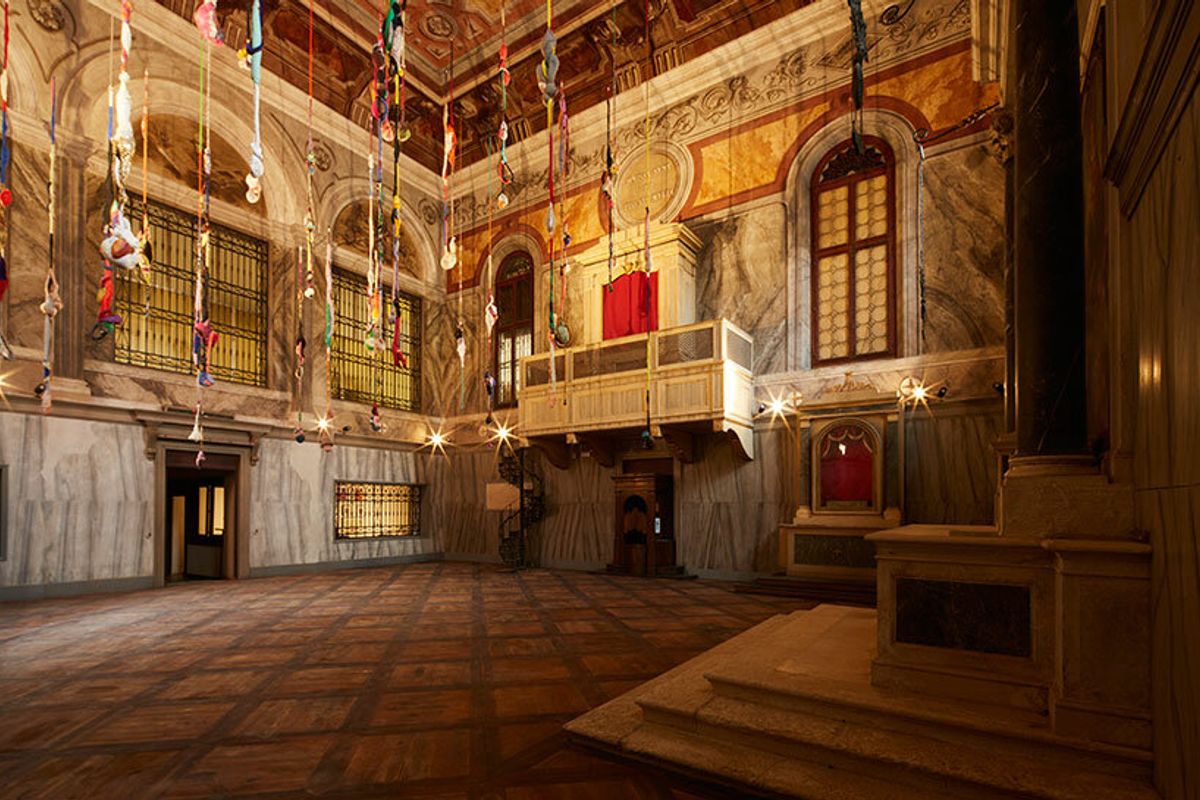
A courtyard. A chapel. A garden where Sonia Gomes had draped her textile sculptures among the plants, the fabric tangled with the tomato vines in a way that made you have to look twice to know which was which. Simone Fattal had made a bronze maquette of a sleeping body on a bed, placed in a common room. Bintou Dembélé had worked with the inmates on choreographed movement, which meant, practically, that some of the guides had also been performers and still were. The video of the choreography played on a small screen in the hall. The guide pointed at it, recognised a friend, said a name aloud, and then kept walking.
The artworks were good, mostly. A few were better than good. Tabouret's portraits are probably the most enduring piece in the show. The point of the pavilion, though, was not the artworks taken one at a time. It was the accumulated fact of who was telling you about them. When the guide said that the fabric in the garden reminded her of her mother, you were not receiving curatorial interpretation, you were receiving a person's testimony delivered in the place that currently limits her movement. You cannot buy your way around this, or criticise your way around it, or quite write it up, because the critical apparatus available to a reviewer in Venice is not the correct instrument for the job.
That is the pavilion's shrewdness. It places you in a situation where your usual gestures do not work. You do not get to take photos. You do not get to linger alone in front of a piece. You do not get to pretend the work exists independent of its context. The pavilion stages a small and necessary collapse of the critic's distance.
Afterwards I sat on the vaporetto back to Zattere and thought about the other pavilions I had seen that week, all of the ones that had been shouting about inclusion from behind a red rope. The Holy See had done something more uncomfortable and more useful. It had put the inclusion in the key that opened the door. The guide had been paid for her work, I later learned, which matters. The paintings will travel without her. The door will close when the Biennale ends. None of this is a solution. But for ninety minutes on Giudecca, inside a working prison, the usual choreography of contemporary art was pleasantly, completely rearranged. I have never written the phrase life-changing in a review. This was closer to that than I expected to come.