A Week That Refuses to Resolve
Milan Design Week 2026. A compressed itinerary, Serotonin in Brera, and the problem of deciding what matters when everything insists that it does.
Milan Design Week does not begin and does not end; it accumulates. By the second day you are already behind. By the third you understand that catching up is not the point. What matters is choosing, and choosing quickly, which is why every serious visitor ends up building a private shortlist and defending it against the city.
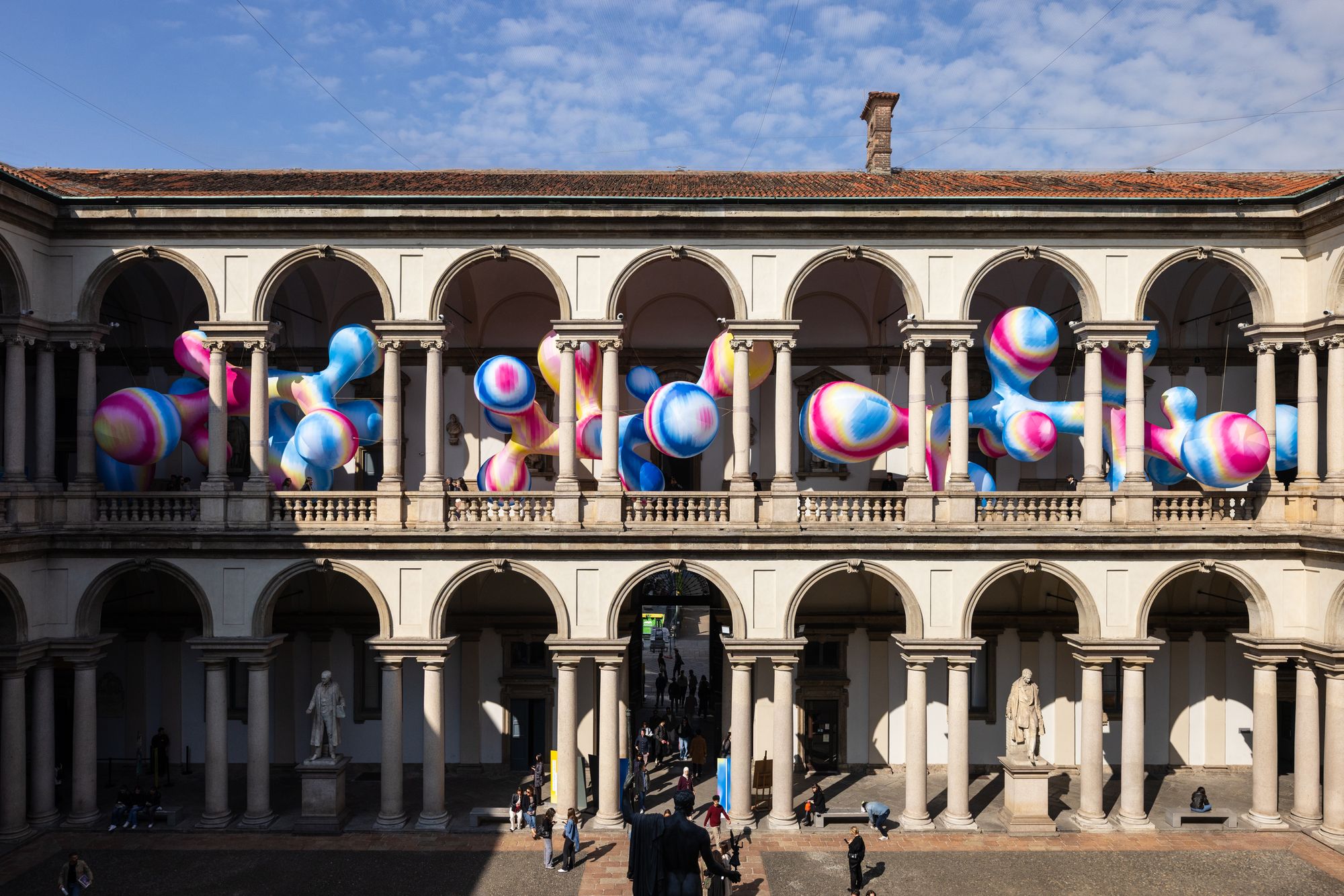
The most circulated image this week comes from the Loggiato of the Pinacoteca di Brera, where Sara Ricciardi has installed Serotonin. The Chemistry of Happiness. Inflatable forms expand and contract in a slow rhythm, filling the colonnade with colour and a faint sense of biological theatre. The work translates a chemical into an environment. It is immediate, photogenic, and slightly misleading. You walk through it once and think you have understood it. You walk through it again and realise the piece depends on duration, on the time it takes for your body to sync with something that is pretending to be natural.
This year’s framing, “Be the Project,” shifts the week away from objects and towards processes. That sounds like a curatorial sentence until you test it against the city. Many of the strongest works are not things but situations: temporary architectures, staged environments, conversations that only exist if you stay for them. The object is still there, but it is no longer sufficient.
At the Università degli Studi di Milano, the annual courtyard installations continue to operate as Milan’s unofficial agora. Large, brand-backed structures absorb and organise the crowd, offering just enough coherence to make you stop before moving on again. The scale is architectural; the experience is theatrical. You are aware, at all times, of being one body among many.
The Triennale di Milano asks for a different tempo. Inside, the work unfolds more slowly, less concerned with immediate impact than with sustained attention. It is one of the few places during the week where you can spend an hour in a single building without feeling that you are missing something elsewhere.
Prada Frames, curated by Formafantasma, has returned with a programme on material intelligence. Nearby, Gucci has staged an installation that leans into scenography and narrative, closer to exhibition-making than product display. Louis Vuitton, continuing its long design-week presence, has presented new objects in a format that sits somewhere between collectible design and brand archive. And the Miu Miu Literary Club has reappeared as one of the week’s quieter anchors: a sequence of readings and conversations that require you to sit down, listen, and stay — which, in Milan, is already a statement.
The districts maintain their established roles. Brera District is efficient and saturated, a grid of galleries, courtyards and brand activations that can be navigated in sequence. Tortona District is louder, more corporate, designed for visibility at scale. 5VIE District remains the most porous, where smaller projects and less stable formats still find space. Each district offers a version of the week. None of them is complete.
The difficulty is not access but filtration. There are, by most counts, hundreds of events running simultaneously. The city encourages movement but punishes hesitation. You walk ten kilometres and feel underexposed. You walk fifteen and realise exposure is not the metric. The week rewards decisions made quickly and, occasionally, arbitrarily.
What emerges, by the end of a day, is not a coherent picture but a sequence of impressions that resist alignment. A breathing installation in Brera. A crowded courtyard in Statale. A quiet room in the Triennale. A reading you stayed for longer than planned. A conversation you half-followed and then lost. The coherence, if it exists, is retrospective.
Milan Design Week has always been described as overwhelming. That is accurate but incomplete. It is also selective, in the sense that it forces you to become selective. The city does not ask you to see everything. It asks you to decide what counts, knowing that the decision will almost certainly be wrong.
By the time you leave, the installations are already being dismantled. The courtyards empty. The inflatables deflate. What remains is not the work itself but the routes you took through it, and the suspicion that a different route would have produced a different week entirely.