Salone Beyond the Chair
Rem Koolhaas and David Gianotten gave the 64th Salone an intellectual frame that had nothing to do with furniture
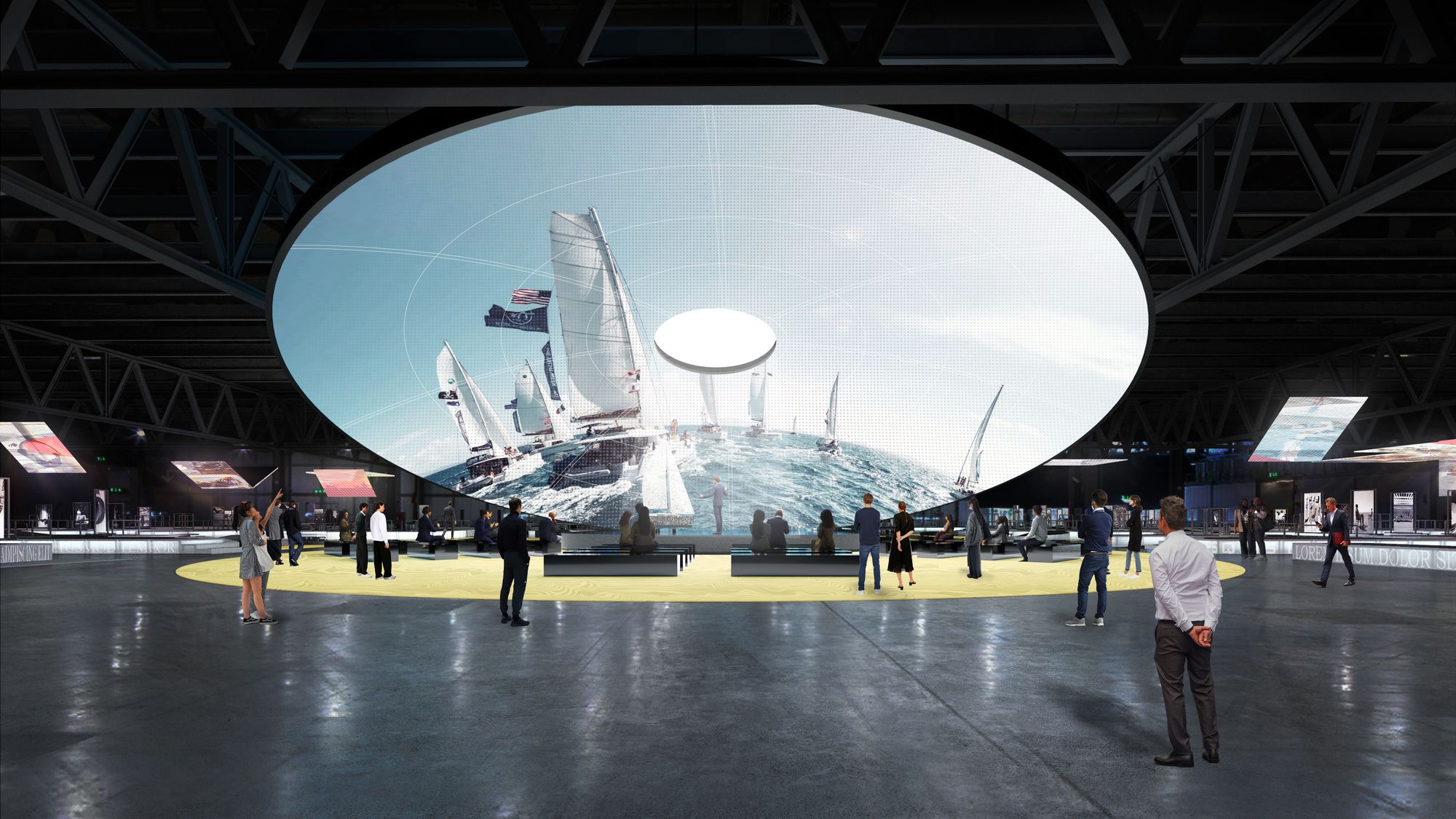
The most heavily discussed shift at the current edition of Salone del Mobile is not a single object, but a change in emphasis. Across the fairgrounds in Rho, it is becoming increasingly clear that the industry is moving away from presenting isolated products towards staging environments — spaces that demonstrate how furniture, lighting, and systems operate together at the scale of real projects.
This is not an entirely new development, but in 2026 it feels more explicit. A number of brands are moving beyond the logic of the standalone launch and are instead building immersive settings: hospitality interiors, workplace scenarios, and domestic spaces conceived as cohesive systems rather than collections of discrete pieces. What is being presented, in effect, is not just a chair or a lamp, but a way of furnishing an entire environment.
In industry terms, this reflects the growing importance of what is often called “contract” work — large-scale projects such as hotels, offices, healthcare facilities, and transport spaces, where design is commissioned as part of a broader architectural or operational framework. Many of the companies exhibiting at Salone have long been active in this sector, but the fair has traditionally foregrounded individual objects. The balance now appears to be shifting.
This shift is visible not only in the installations themselves but also in the surrounding discourse. Talks and panel discussions are increasingly addressing themes such as systems integration, material performance in high-use environments, logistics, and long-term maintenance — concerns that sit closer to architecture and operations than to product styling. The language of the fair, while still anchored in design, is expanding towards that of infrastructure.
The response to this evolution is mixed. For many established Italian manufacturers — companies that have built their identity around iconic objects — the fair remains, fundamentally, a place where products are launched, seen, and circulated through media and retail channels. The chair, in this sense, is not just a product but a cultural format.
At the same time, younger studios and more globally oriented brands seem comfortable with a broader definition of what is being presented. For them, the object is often only one element within a larger system, and the fair becomes a platform to communicate that system rather than to isolate a single piece.
You can see this clearly in a number of installations by brands such as Flos, Poltrona Frau, and Kohler, where the emphasis is placed on complete spatial scenarios rather than individual hero objects. These presentations function less as showcases of products and more as demonstrations of how those products operate together — technically, atmospherically, and commercially.
There is, however, a tension built into this direction. Large-scale environments are, by their nature, less easily reduced to images. They do not circulate through media in the same way as a single, highly photogenic object. The fair has long depended on this circulation — on the ability of a chair or lamp to stand in for a broader narrative. As the focus shifts towards systems and spaces, it raises the question of how that narrative is communicated.
What is emerging is not a replacement of one model by another, but a rebalancing. The object remains central, but it is increasingly understood as part of a larger whole — one that extends beyond the fair itself into the kinds of projects that now drive much of the industry.
In that sense, the most important development at Salone is not a specific product or installation, but a gradual reframing of what, exactly, is being exhibited.