The Listening Room at Al Qasimiyah
Bilna'es, the publishing collective that came out of supporting artists in Palestine and the diaspora, took a set of classrooms at Sharjah Biennial 16 and made them a listening station.
Bilna'es was founded as a publishing space in the months after October 2023. The premise was small and specific: there were artists in Gaza and the West Bank, and in the broader diaspora, whose work needed a way out, and whose institutional support was either collapsing or had never existed. The platform described itself as adisciplinary, which in practice meant that it released music, video games, performances, prints, and web objects with the same editorial attention, and treated the boundary between these forms as mostly a bureaucratic problem. By the time Sharjah Biennial 16 opened on the 6th of February 2025, Bilna'es was two years old and had built a distinct editorial practice. Its invitation to the biennial came in the form of a group contribution, curated by Adam HajYahia, titled Speaking with the dead.
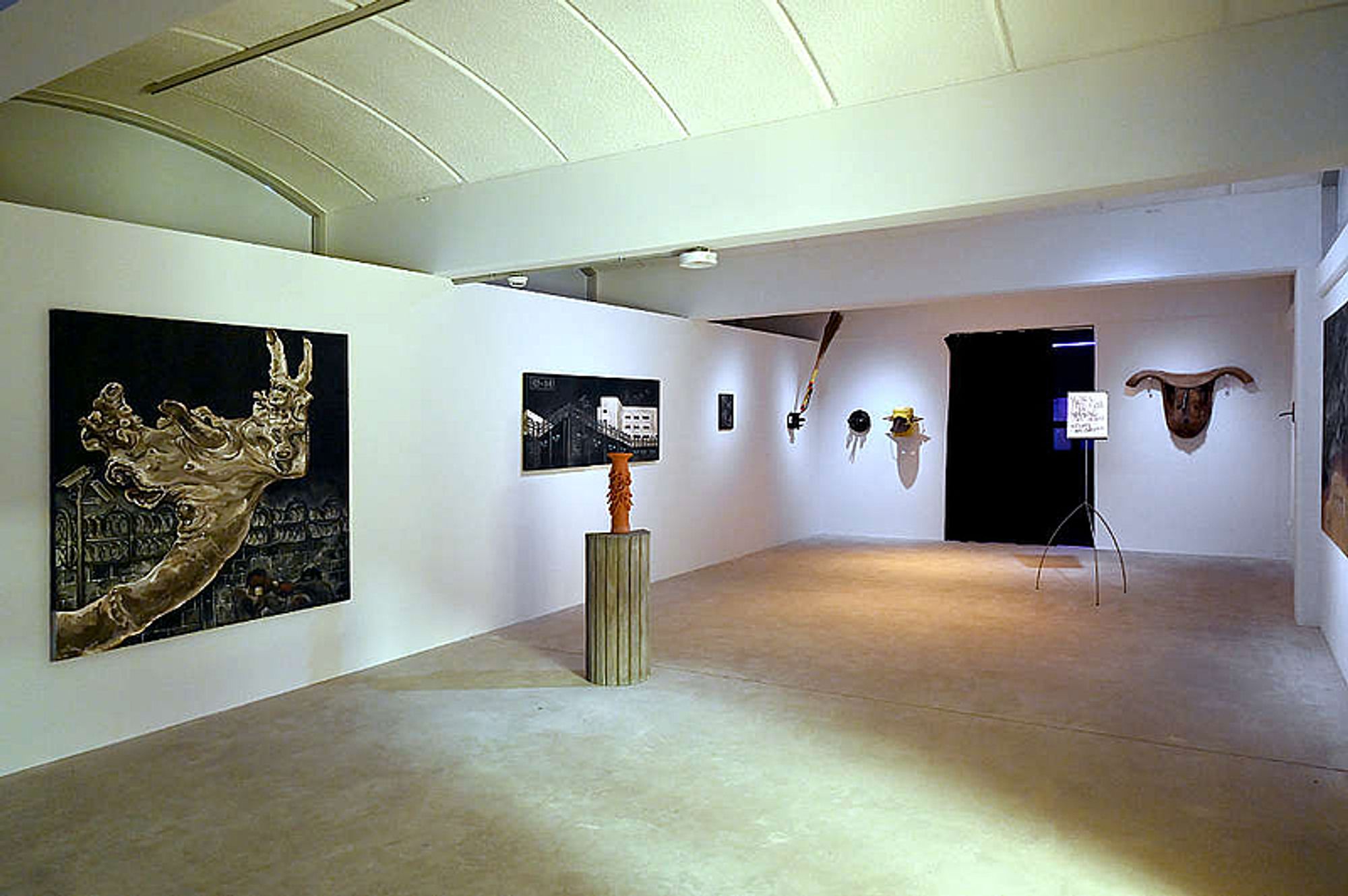
The show was installed at Al Qasimiyah School, the former public school building that Sharjah Art Foundation uses as its headquarters and as one of the biennial's quieter venues. HajYahia had taken a set of classrooms, stripped back to the plaster, and made each one a chapter of the argument. The visual contingent was on the walls. Muhannad Al Azzeh's prints on labour and agriculture. Jota Mombaça's text works on debt and disappearance. Dina Mimi's video pieces on the logistics of return. Oscar Gardea's drawings. A late Martin Wong archive loan. The wall text made a single argument, and the rooms underlined it: debt is a shape the modern world takes when it wants to extract from people without naming the extraction.
In the next room along was the listening station. Bilna'es had released, earlier in 2025, a vinyl compilation titled Only sounds that tremble through us. The title was borrowed from Basel Abbas and Ruanne Abou-Rahme's ongoing body of work. The compilation gathered tracks from the platform's music catalogue, which skews heavily toward Palestinian producers and their international collaborators. HajYahia had installed a turntable in the middle of the room, with the records in a wooden crate beside it, and visitors queued to drop the needle. On the first Saturday I went in, Muqata'a's tracks were on rotation. On a later visit, a Drew McDowall and Hiro Kone release was playing, which did not entirely match the register of the rest of the room and, for that reason, worked.
Abbas and Abou-Rahme's contribution was a sound work assembled from archival fragments they have been gathering from Palestinian family tapes for the last decade. You could listen to it through headphones at one end of the room, seated on a low bench. The piece did not annotate the footage it drew from. It did not explain. It sat on the record as sound, which, at the scale of a listening room in a former classroom in Sharjah, was the right decision. Any other approach would have felt like translation.
The effect of the room is hard to pin down without slipping into the language of advocacy. Speaking with the dead is not an activist exhibition in the usual sense. It does not instruct. The room gives visitors time and furniture to sit on. Everything else is on the record. In a biennial of seventeen venues and nearly two hundred participants, the listening room asked for patience and rewarded it.
Outside the school, the Al Qasimiyah courtyard has a fountain and a small cafeteria and, in February, the kind of afternoon light that makes the emirate's modernist heritage legible. I sat on the low wall for half an hour after leaving the listening room, unable to return to the schedule, and watched two visitors arrive. They did not know the biennial's theme. They had come because a friend had told them about the records. They went in, and stayed for an hour. When they came out, they looked different. That a listening room in a former classroom did this, and did it without staging grief as performance, is worth turning over.
Sharjah Biennial 16 closed on the 15th of June 2025. Speaking with the dead will travel, in some form, to one or more European institutions in 2026. Whichever institution inherits it would do well to resist the temptation to scale it up. What HajYahia and the Bilna'es platform built at Al Qasimiyah worked because it was a room and a turntable. The ambition was local. The reach was not.