The Fair That Isn't a Satellite
Art Dubai's 17th edition tested the argument that Dubai is a centre rather than a waystation. The evidence was in the rooms.
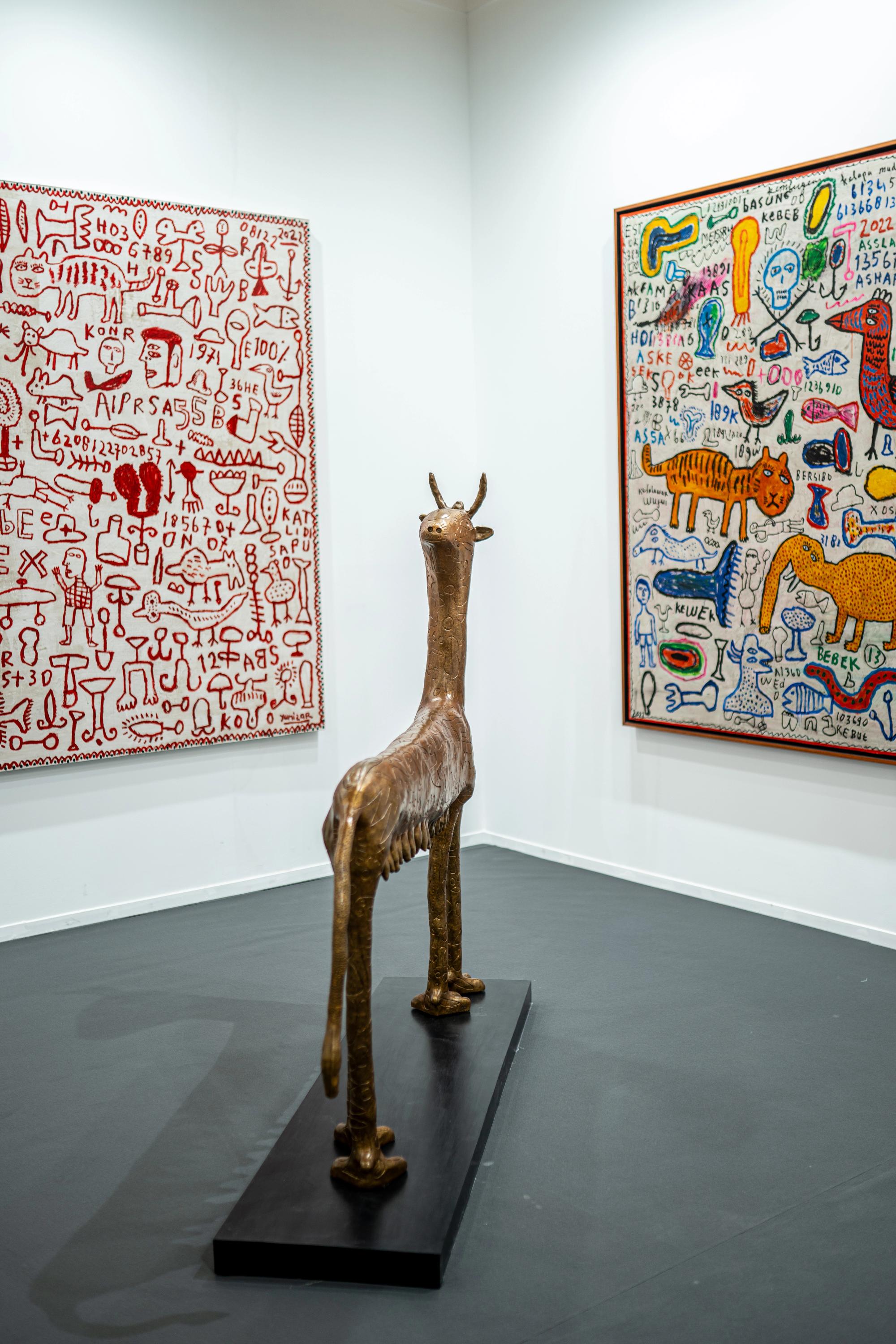
Art Dubai's 17th edition ran from the 1st to the 3rd of March 2024, at Madinat Jumeirah, the beach-side hotel complex on the Palm side of Dubai that the fair has used as its home since 2007. 120-odd galleries. The usual regional mix: a strong core of Gulf and MENA galleries, a growing South Asian and South-east Asian contingent, a selection of European galleries whose directors are increasingly fluent in which end of the fair they should be at, and, this year, a noticeably heavier Asian collector presence than I had seen at previous editions. The theme was community and belonging. The sections were Contemporary, Modern, Bawwaba and Digital. The Bawwaba section, under the Colombian curator Emiliano Valdes, had the theme Sanación, meaning healing. I will come to that in a separate piece.
The larger question Art Dubai asks, and has been asking more pointedly in the last three editions, is whether Dubai is a centre of the art world or a satellite market of Europe, New York and London. My view, which I held before this year and hold more firmly after, is that it has become a centre. This is not a Dubai-promotion sentence. It is a recognition that the routes by which collectors in Lagos, Riyadh, Hong Kong, Mumbai and Lahore transact with galleries have increasingly been running through Dubai rather than through the European capitals. The infrastructure, the free-zone logistics, the time zone, the relative ease of movement for collectors from the Global South. The fair is the smallest visible part of that shift.
Inside the tents, the Modern section had its usual quiet strength, with a handful of Lebanese, Egyptian, Iraqi and Iranian galleries showing twentieth-century work that is still underpriced in world-market terms and undervalued in world-art-historical terms. Saleh Barakat Gallery from Beirut had a strong hang of Paul Guiragossian. Gallery One from Ramallah had three Sliman Mansour paintings that brought people back to the booth twice. A Dubai-based gallery I had not previously paid attention to, Meem, had an excellent Safwan Dahoul. There is a particular pleasure in walking through a section where the work is not yet priced at New York levels and you can still see how history is being settled.
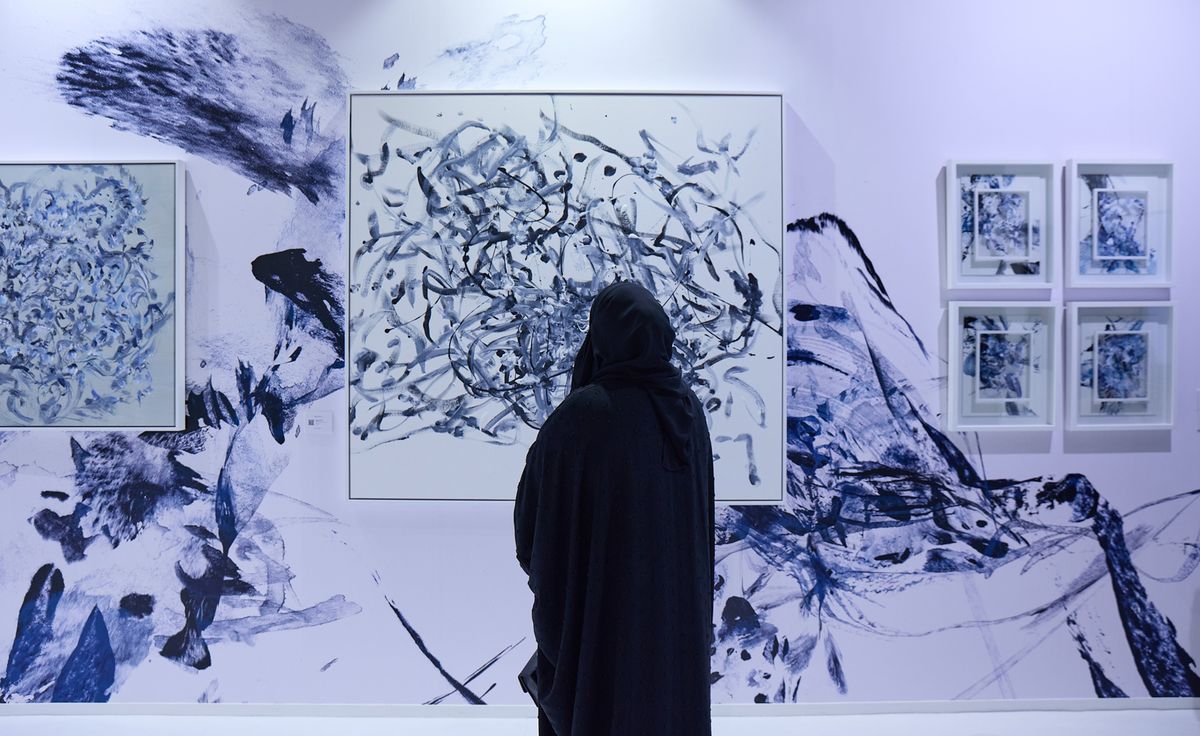
Contemporary was more mixed, as always. The Dubai-based galleries that are now the fair's spine, Green Art, The Third Line, Carbon 12, Gypsum from Cairo, showed a mix of old and new. Green Art had a room of Hayv Kahraman paintings that were the strongest new figurative work I saw that week. The Third Line had a Farah Al Qasimi photographic installation whose humour would have travelled well in Venice. There was the usual smattering of international galleries showing the kind of mid-career American work that sells at Dubai because the collector wants a Condo and is not flying to New York to get one.
Digital, the fair's section for what used to be called new media and is now, more aggressively, digital art, had shrunk from its 2022 NFT-era size and grown in quality. A Larry Achiampong VR piece was worth putting the headset on for. An Iranian artist I had not seen before had a generative work that slowly, over the course of a long visit, rebuilt Tehran from its satellite shadow. Digital at Art Dubai is now about three-quarters the section's physical size of two years ago and twice its conceptual ambition.
Around the fair, the rest of the Dubai art infrastructure was doing its job. Alserkal Avenue had a strong programme, with shows at Ishara Art Foundation and at Lawrie Shabibi and at Concrete that would have held up in any European art city. Jameel Arts Centre, on the creek, had a retrospective of the Algerian modernist M'hamed Issiakhem that, on a Friday afternoon, was nearly empty of tourists and nearly full of serious looking. The Louvre Abu Dhabi and Guggenheim Abu Dhabi are the macro institutional news. The micro institutional news is that Dubai has a working art ecosystem now. It has artists, it has galleries, it has critics, it has audiences. It has not always had all four at once.
There is an argument you still hear about Art Dubai, which is that it is the fair you go to see the work that does not travel to Art Basel. The argument is not wrong. It is also not the whole point. The fair's best work, the work you notice and remember, is work that is made in conversations between Dubai and Tehran and Lagos and Mumbai, not work that is shuttled in from Chelsea for the week. That is what a centre looks like. The satellite would be the one flying work in. Art Dubai, this year, was more often flying work out.
I left on the Sunday night, coat in hand because Dubai in early March is still cool enough to need one at the airport, and I thought about how much of the art that matters in 2024 passes through this fair at some point in its life. Not all of it, of course. More of it than used to.