The Chalk Lasts Longer Than You Do
Archie Moore's "Kith and Kin" is the quietest room in the Biennale, and it won the Golden Lion for exactly that reason.
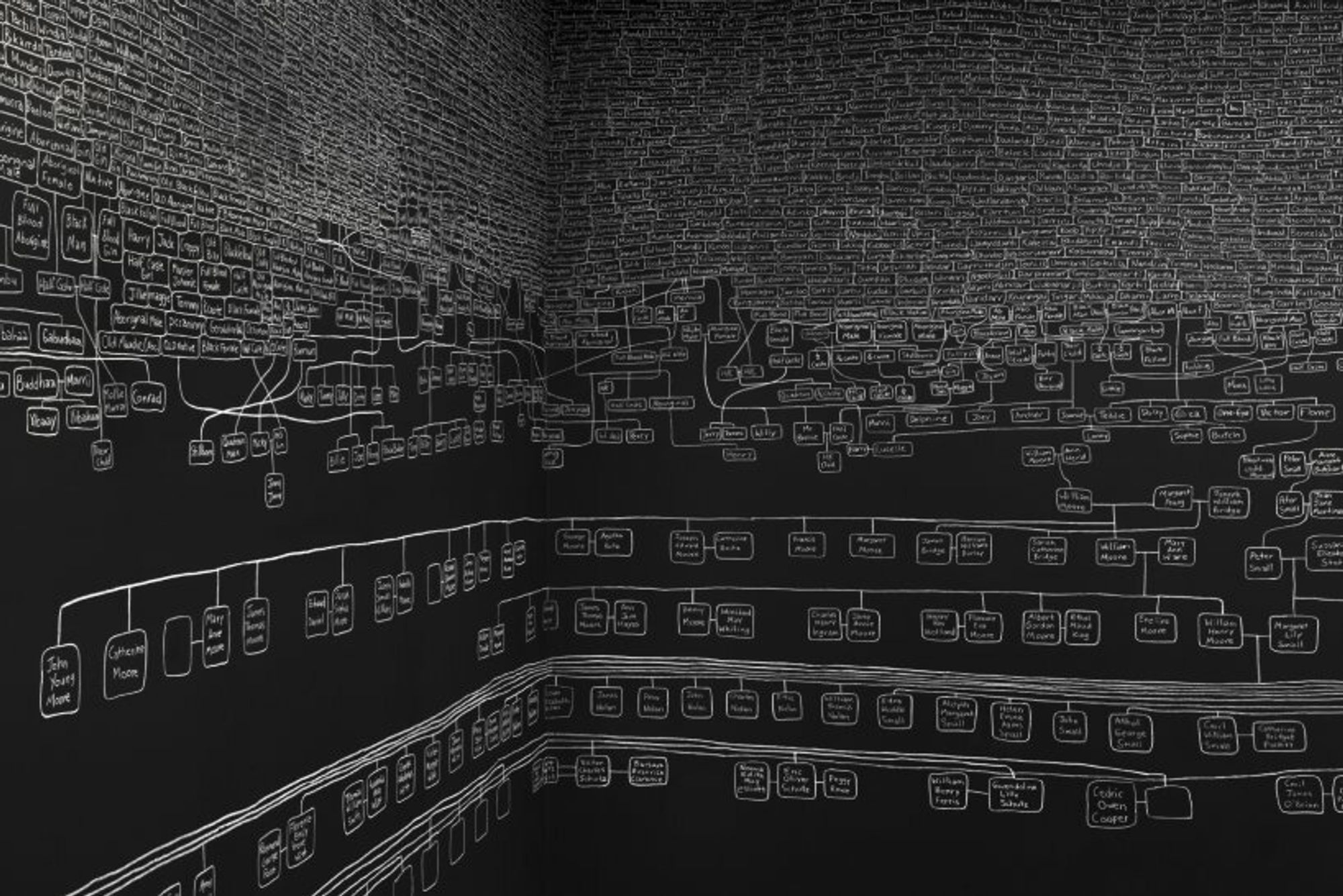
The Australian Pavilion at the Giardini is a dark, granite-clad box. This year Archie Moore painted every interior surface matte black and wrote his family tree across sixty metres of wall and ceiling in white chalk. The lineage goes back 2,400 generations, or about 65,000 years, because Moore is Kamilaroi and Bigambul on his mother's side and British and Scottish on his father's, and Kamilaroi genealogies do not flatter the Enlightenment by stopping at it. He called the work Kith and Kin. It won the Golden Lion for Best National Participation. It was the first time an Australian had won.
You come in off the Giardini path, which is full of children and catalogues and cold beer and the usual clatter. The pavilion door is unmarked. Inside it is quieter than it has any right to be. The chalk starts low on the wall, by your knee, and works up past your head and onto the ceiling. Some names are redacted. The ones on the wall that are not redacted are written in Moore's hand, which is patient and a little careful, the hand of someone who has to keep the letters legible across a very long horizontal.
In the middle of the room is a long reflecting-pool table. On it sit neat stacks of paper: photocopied coronial inquest documents from the 557 Aboriginal people who have died in Australian police and prison custody since 1991. Not all of them have inquests. The ones that do have had the identifying information blacked out. You cannot read most of what is on the pages. That is part of what you are looking at.
Moore has spent hundreds of hours on this, much of it on Ancestry.com, some of it cross-referencing the amateur anthropologist Norman Tindale, who in 1938 interviewed Moore's maternal great-grandmother and drew up a genealogical chart of his own. Tindale's chart is the skeleton underneath parts of the wall. The deep history, the 65,000 years, is Moore's own. You can read the chalk if you want. Most visitors do not, or they read for a minute and then stand in the middle of the room and stop reading.
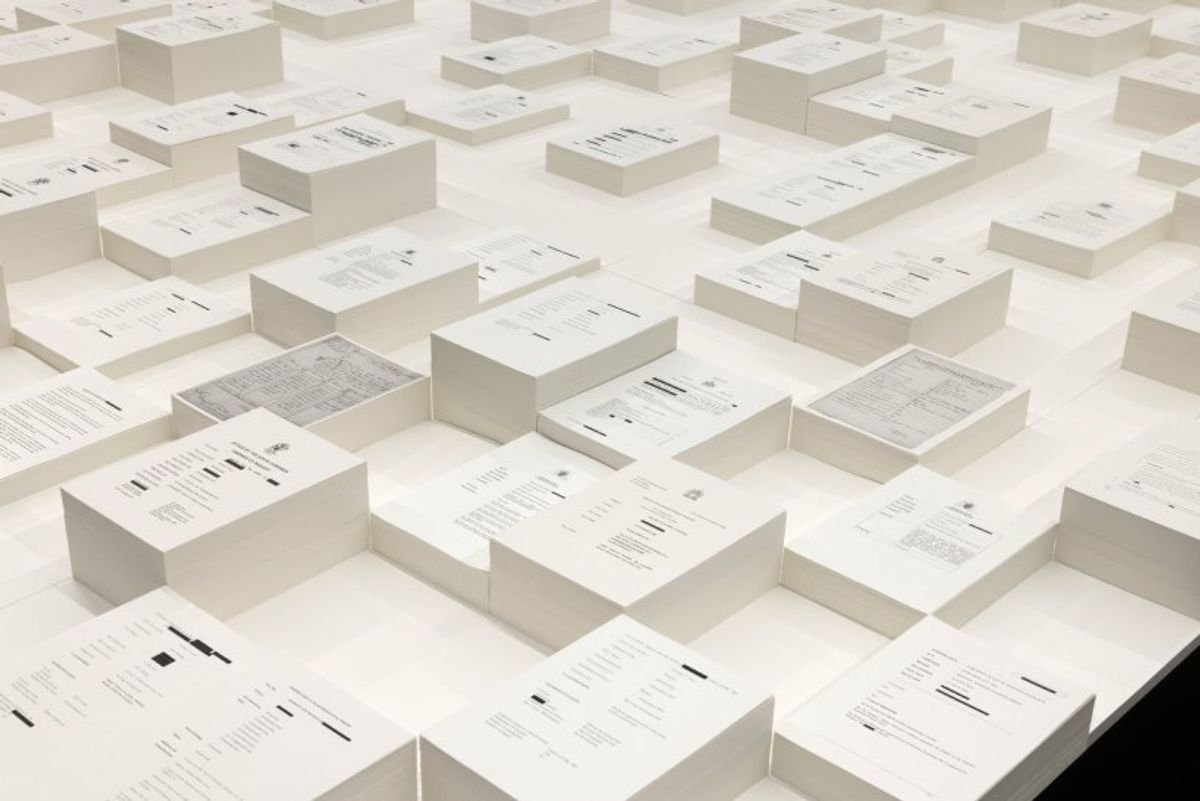
This is the work's discipline, and it is also why the jury gave it the Lion. There is a version of this pavilion that is loud. It paints names in red, plays a score, loops a video of the Stolen Generations. Moore has made the quieter version. No wall text screams at you. No headphones. Just a ceiling dense with names, a table of redacted official documents, and a room temperature that pushes you to whisper.
The chalk is the point. Moore chose it because it wipes off. When the Biennale closes in November, the pavilion will be painted over, and the 2,400 generations will go back to being held somewhere that is not a wall in Venice. Some people reading this will find that a shame. Moore is the one who wanted it this way, because the fragility is the argument. A name written in chalk lasts longer than most of the institutions that tried to erase it, which is a claim that sounds like sentiment until you have spent twelve minutes in the room and realise that the institutions the chalk is outlasting are the same ones that built half the city you are standing in.
There is a conversation in Venice this year, loud and a little performative, about whose stories are being told. Kith and Kin does not join that conversation. It just tells one. The distinction matters. A pavilion that argues for representation can still feel like a press release. A pavilion that shows you a specific family, a specific set of deaths, a specific hand's worth of chalk, is already past argument.
I walked through twice, on different days. The second time it was full of people and still quiet. When I left I could not tell you what I had seen in terms of a thesis. I could tell you it was cold. I could tell you the ceiling pressed down in a way that made you look up more than a ceiling usually does. I could tell you that, somewhere near the back left corner, at knee height, the name of someone born in the 1830s sat next to a number I had seen on one of the inquest papers on the table, and that I noticed because they were near each other, and that the pavilion is doing this kind of arithmetic on every surface for anyone willing to spend the time.
Good art does not always announce itself. This one does not announce itself at all. It just waits there, in chalk, on a black wall, and trusts you to look.