Pesce in the Entrance
Design Miami/ Basel's 18th edition opened ten weeks after Gaetano Pesce died. The shadow sat over the fair like weather.
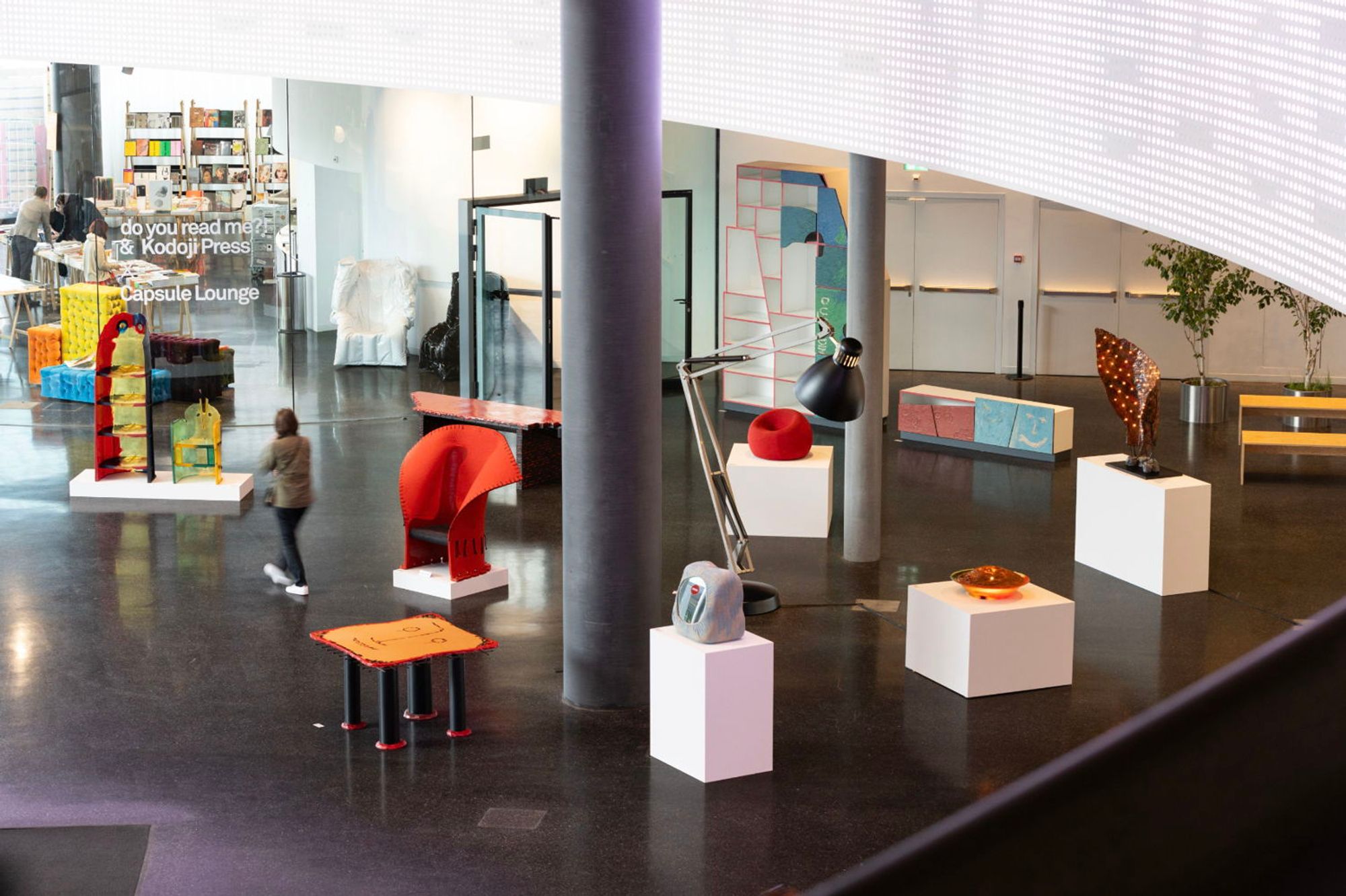
Ten weeks after Gaetano Pesce died in Milan, three galleries clubbed together to put a selection of his work in the entrance hall of Design Miami/ Basel. You came in from the heat of the Messeplatz, walked past a Pratt Chair and a pair of his polyurethane lamps, and by the time you reached the Curio rooms you had already been reminded what a strange and stubborn life in objects could look like. Pesce was 84. He had spent sixty of those years insisting that a chair could be a drawing, a lamp could be a slogan, a resin poured badly could be the whole point.
His Pratt Chair n°7, presented by Pulp at its Curio debut, took Best Historical Design Object. You could see the choice going either way. The Pratt chairs, made in resin in the mid-eighties in gradients from unusable to structurally sound, are an argument against design as pure utility. A chair that can't quite hold you is still a chair, according to Pesce. The jury, on its own time, agreed. The booth recreated a section of the Centre Pompidou's 1996 retrospective Le Temps des Questions, with scenography borrowed from an Italian garden. It felt correct without feeling mausoleum-like, which was the harder note to hit.
Basel in June is a hot city that pretends to be a cool one, and the fair has always leaned into this. You sweat through Liste in the morning, you have a Rivella, you walk across the Rhine, you arrive at Messeplatz feeling slightly like you have earned something. Design Miami/ Basel, in its 18th edition, still has the quality of a younger sibling to Art Basel next door. Smaller and more specific. Also more fun, because the objects in it have a different relationship to the buyer than paintings do. You can sit on most of them. You are not supposed to, but you can.
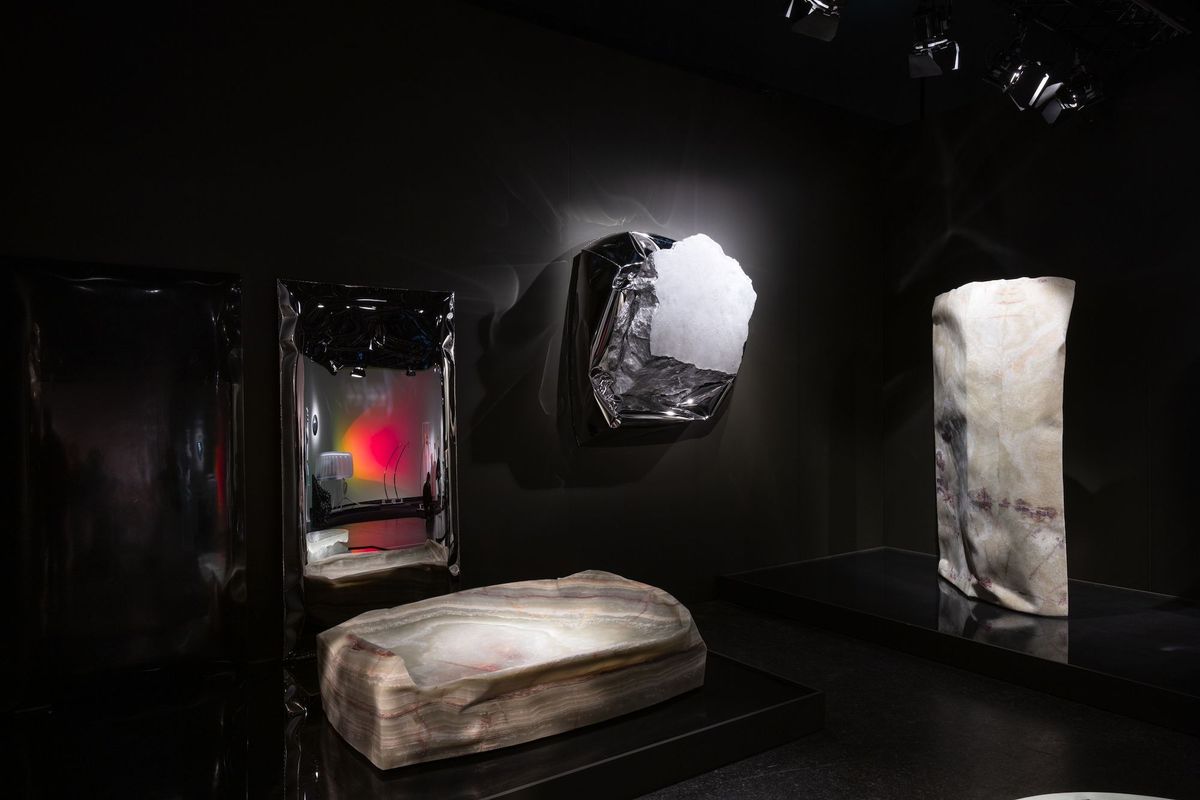
Among the first-time exhibitors, the strongest was Objects with Narratives out of Brussels, with a solo show by the Belgian designer Ben Storms. He called it Liquid Solids, and the phrase did what it said. Consoles in inflated steel, their surfaces taut and bellied the way a gas-filled balloon is taut. A wall piece in cast bronze that looked like someone had paused it mid-pour. It is the kind of work that makes you want to knock on it to check which assumption was right, the eye or the hand. I didn't, but I watched two other people do it.
Maxime Flatry, out of Paris, staged a Jean-Michel Frank solo, which on paper was a curator's idea and in the room turned out to be a designer's. A Lit parchemin. A few chairs. A lamp. Not much else. Frank's famous phrase, furnish by unfurnishing, was quoted in the wall text, and the booth took it literally. There was more air than object in the stall. It was a good answer to the larger fair's maximalism.
At Eva Presenhuber, a Franz West solo featuring Senseless (2008/2014). West is a painter and sculptor being claimed here as a designer, which Presenhuber handled with the neutrality of someone who knows what they are doing. The pieces sit in the uncomfortable middle between chair and object, which is exactly where West wanted them. The booth was quiet. Most people walked through it. The ones who stopped stopped for a while.
The best Curio was Craft x Tech out of Tokyo, a group project pairing traditional Japanese craftspeople with contemporary designers. Sabine Marcelis had worked with Akita artisans in Kawatsura-shikki lacquer, the kind that builds up in fifty coats over months. Her vitrines were red and dense and modest, and you could not tell where the craft ended and the design began, which was the point. Ini Archibong, based in Neuchâtel, had turned Tsugaru-nuri lacquer into the body of a musical instrument. The instrument made a sound you had to lean in to hear.
Friedman Benda, which always turns up with the densest list, showed eight designers in what amounted to a group recital, including Wendell Castle and Barbora Žilinskaitė. Castle's stuff still reads as if it has opinions, which is a compliment. Žilinskaitė's Sunbather, a creature lounging on a bench like it was waiting for a drink, was the piece that got photographed the most. I can see why. It is funny without being cute, which is a threshold more designers should aim at.
A fair like this always raises the question of what it is for. Art Basel runs a few hundred metres down the road and absorbs most of the attention and most of the cheques. Design Miami/ Basel, smaller and more particular, sells chairs to people who already own chairs. It is a fair for collectors of a certain kind of object, yes, but it is also, and this is the part the press releases never say, a chance for designers to show what they would make if no one was buying it for a hallway in a second home. The best booths this year leaned into that freedom. The Pesce entrance, a memorial to a designer who worked for decades inside exactly that freedom, was the right way to open the thing.