Paris Stayed
The second Art Basel Paris under the Grand Palais's glass roof sold well and behaved like a fixture. It was not trying to prove anything, which was the point.
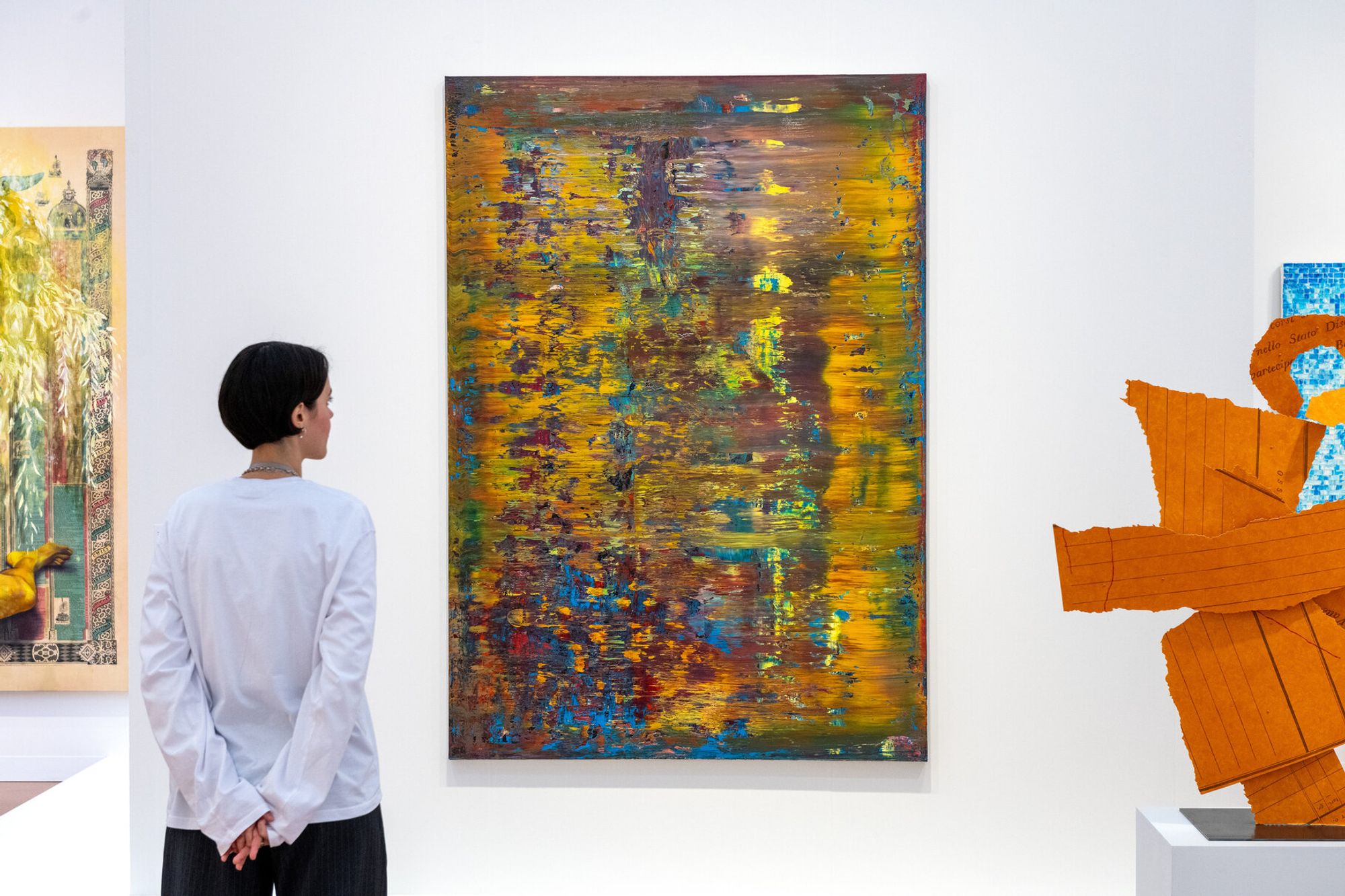
Art Basel Paris's second edition at the Grand Palais ran from the 24th to the 26th of October 2025, with VIP days on the 22nd and 23rd. 206 galleries, 63 of them French, more than 73,000 visitors, the usual cohort of museum delegations and the usual one sitting French president. On the Saturday morning an eight-metre-high Takashi Murakami octopus sculpture stood on the Champ-de-Mars in front of the Tour Eiffel, a Louis Vuitton commission for the fair's public programme, and by Sunday night most of the people you know who care about this kind of thing had been photographed in front of it. The mood at the fair, for those of us who had been grudging about Art Basel Paris's first edition twelve months earlier, was that it had landed.
Last year's debut at the Grand Palais had been the rehearsal. The exhibitors knew they had a good venue. The question was whether Paris could support this fair annually at this scale without cannibalising Art Basel in Basel in June. The answer, this year, was yes, with qualifications. Prices went up, attention went up, sales went up, mood went up. The American collectors who had held back in June came to Paris. The Asians came through. The French buyers, traditionally polite about fairs and only really buying in a few targeted booths, bought more widely than they have in a long time. Julie Mehretu's Charioteer, 2007, went for $11.5 million at White Cube. Bruce Nauman's Masturbating Man, 1985, went for $4.75 million. A Condo went for $4.5 million. A Fontana went for €3.5 million. These are top-of-market sales, made quickly, in the first forty-eight hours. For those of us who cover this professionally, the numbers matter less than the pace. Pace is what a good fair sells.
The building continues to do the work. The Grand Palais's nave, when the autumn light comes through the iron-and-glass roof at three in the afternoon, is as good a space to show art in as exists anywhere in the world. David Zwirner had a Luc Tuymans room that was nearly museum-grade. Hauser & Wirth had pulled out a major Philip Guston and built around it. Thaddaeus Ropac had a Rauschenberg combine on one wall and a room of Arlene Shechet opposite that went faster than most people expected. Gladstone had a beautiful Carrie Mae Weems hang. Victoria Miro had a new Grayson Perry room that, whatever you think of late Perry, was drawing crowds. The strongest booth in my view was Sadie Coles's, which had risked a monographic hang of Sarah Lucas that did not sweeten anything.
Premise, the curated sector introduced in 2024, has started to do what the board hoped it would. This year's standouts were a Mayor Gallery London booth on the forgotten Brazilian kinetic group of the 60s, a Chantal Crousel room given over to a single Roberto Cuoghi project, and a Zurich gallery I had not previously paid much attention to, with a tight monograph of the Polish-Swiss painter Pavel Pepperstein. Premise is still a minority of the fair by floor space. It is increasingly the section journalists spend the longest in.
Emergence, the young-gallery sector, was less even than Premise and more interesting booth by booth. The Crèvecoeur booth with a Simon Dybbroe Møller solo was a pleasant discovery. Gypsum Cairo had a strong room. Some of the other booths felt like rookies, which is fine, because that is what Emergence is for.
The public programme had taken over nine sites around the city. Loïc Prigent had curated a conversation series called Oh La La. Louis Vuitton had been made the public programme's official partner, which had made the Murakami octopus possible. Miu Miu had sponsored a talks programme. A Camille Henrot commission was in a courtyard near Concorde. A Kiluanji Kia Henda installation had taken over the old interior of a pharmacy in the 9th. Paris was on. This is the thing about October in Paris that Art Basel's New York owners have been, I suspect, a little surprised by. Paris turns up.
A quieter note. The fair was taking place in a France with worsening political instability, a collapsed government, and a November budget that was going to increase taxes on exactly the collectors most active on preview day. A few dealers mentioned this quietly. None of them loudly. Fairs this big have a particular relationship to political weather. They function partly as escape rooms from it. Whether this is healthy is a different conversation.
My favourite single work at the fair was at Lévy Gorvy Dayan, a small Alice Neel portrait of a young man in a blue shirt that had the quality of a whole novel. It was priced at four million. It was sold by Friday. Someone I know was close to buying it; someone richer got there first. That is the story of most fairs. Paris, this year, had that story in every aisle. It has a fair now.