Opera Aperta
The Holy See's pavilion at the 2025 Architecture Biennale was a building being fixed. The fixing was the exhibit.
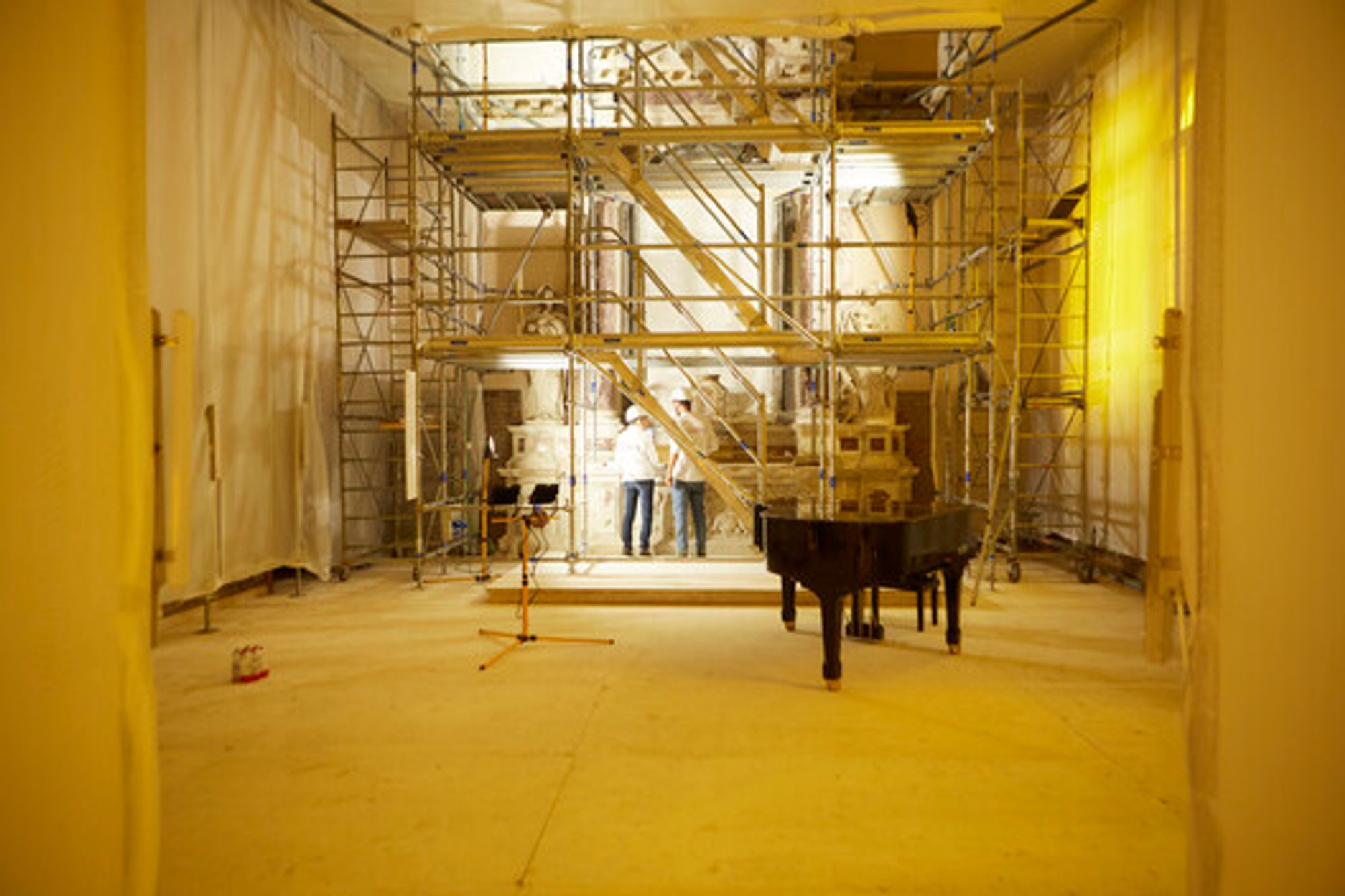
The Holy See pavilion this year sat inside a seventeenth-century complex in Castello, Santa Maria Ausiliatrice, which the Vatican had identified years ago as in need of structural and surface restoration. The pavilion's curators, the architecture collective MAIO Architects with the theologians and art historians of the Dicastery for Culture and Education, made a decision that is either very clever or very obvious, depending on how long you spend in it. The decision was to exhibit the restoration. For the six months of the Biennale, the pavilion's artwork was the active work of restoring the building, performed in front of visitors by the craftspeople carrying it out. They called it Opera aperta. Open work. The jury gave it a special mention, and fair enough.
You walked in, through a scaffolded entrance, into a nave half finished. A fresco was being consolidated on a west wall by two women in overalls and N95 masks. On the opposite wall, a mason was tuckpointing a limestone arch. A carpenter was rebuilding a balcony. None of them stopped when you entered. A wall text explained the logic of the restoration, which materials were being used, what the bones of the building had been and what it was being returned to. There were no artworks in the traditional sense. There was the building, in a state of becoming itself.
This is an old idea. Umberto Eco's Opera aperta was published in 1962, an argument that the meaning of a work is not fixed by the artist but is completed by the audience. The MAIO curators have given the title a very literal second meaning. The work is open because the work is still underway. Their argument is that buildings are always in the middle of being made and that restoration is not a separate category from design. Most of what we think of as original architecture is already several layers of restoration stacked on top of a structure that was itself a modification of something older. This church has been restored six times since 1670. The seventh restoration was the pavilion.
Some of the craftspeople were from the Istituto Centrale per il Restauro in Rome. Others were local Venetian artisans, hand-selected by the Dicastery. A few had apprentices with them, young people working alongside masters whose skills are not well transmitted anywhere else. The pavilion was, in that sense, also a statement about training. It is easy to make buildings. It is difficult to repair them. The second skill is disappearing faster than the first.
The politics of a Vatican pavilion presenting craft rather than icon are worth noting. Two Biennales in a row the Holy See has declined to show you what you expected. In 2024 it took over a women's prison and made the inmates into pavilion guides. In 2025 it took over one of its own buildings and made the restoration into the show. In both cases the pavilion refused the representational mode. In both cases the refusal was the most interesting decision at the Biennale.
The work took up the whole of the pavilion's run. You could come in May and see the west wall fresco at an early stage. You could come back in October and see it consolidated. A few Venetian locals did this. I know because I met one, a photographer who lives near San Francesco della Vigna, who had been three times and meant to come once more before it closed. He said it was the only pavilion that felt like it was telling him the truth about his city. The Biennale is often accused, not wrongly, of being a show about Venice that Venetians ignore. This pavilion, alone among this year's show, got some Venetians to come.
There was a discipline in it. The building was not finished when the Biennale ended on the 23rd of November. The restoration continues. The pavilion continues, in a sense, minus the audience. This is the reverse of the usual Biennale logic, in which a pavilion is built, occupied, and then dismantled. Santa Maria Ausiliatrice was neither built nor dismantled for this Biennale. It was used, carefully. When the audience leaves, the work goes on, which is what the title promised. A Vatican pavilion should probably always have ended this way.