Healing, and the Kitchen
Emiliano Valdes's Bawwaba section at Art Dubai 2024 was built around the theme Sanación, meaning healing. The most literal response to it was a fully functioning Palestinian kitchen.
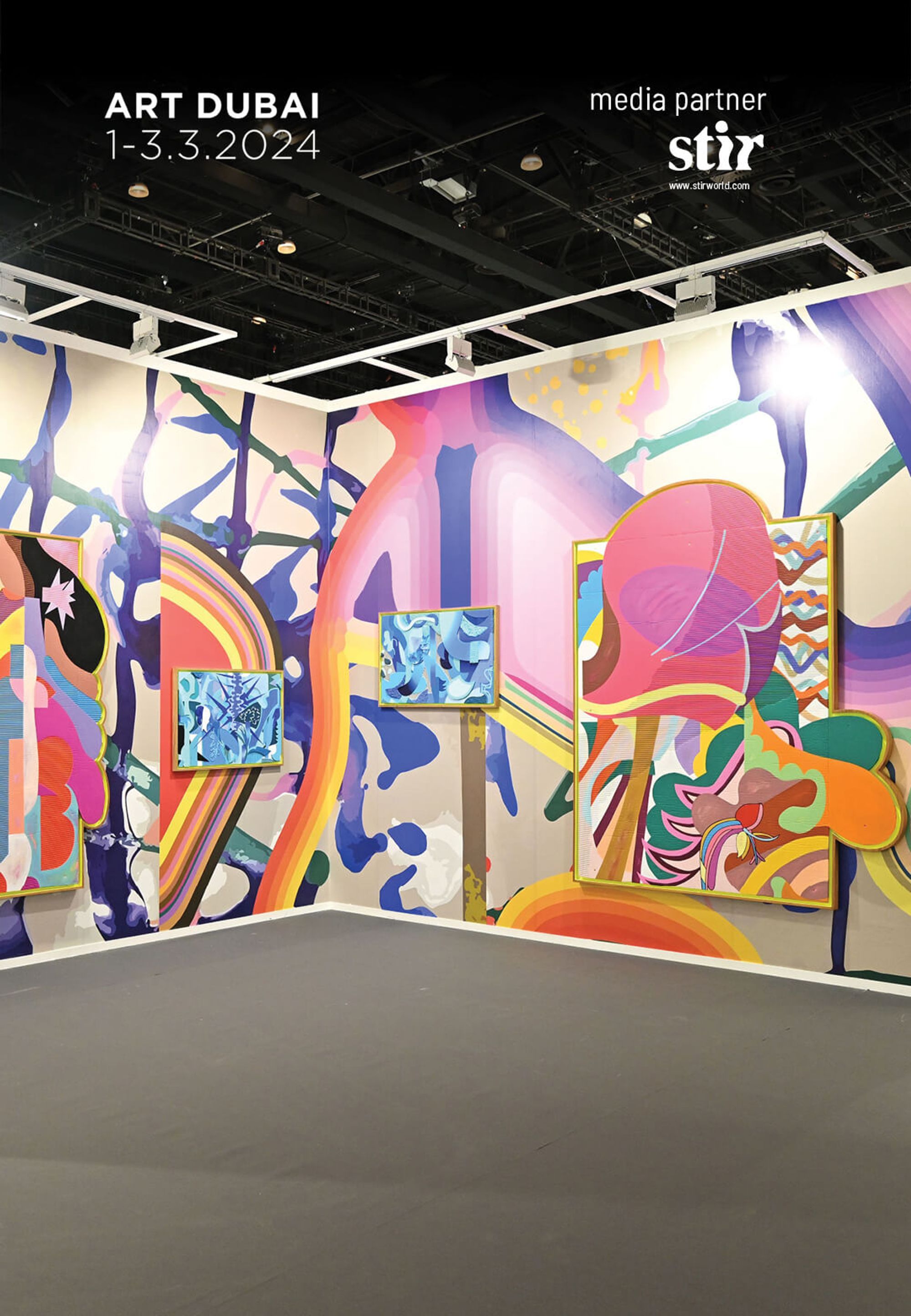
Bawwaba, which means gateway in Arabic, has been Art Dubai's curated section since 2019. Each year a single curator is given it, and the section serves as a thesis within the fair. In 2024, the Colombian curator Emiliano Valdes had chosen to call it Sanación, which translates as Healing, and to commission twelve galleries from the Global South to respond to it. I spent most of my first morning at the fair in Bawwaba and kept going back through the three days.
The strongest work in the section was Sour Things: The Kitchen, by the Palestinian artist Mirna Bamieh, at Dubai's NIKA Project Space. The piece was what it said it was. A functioning kitchen, built into the booth, staffed during fair hours by Bamieh and a small team of assistants. On one wall, the shelves were lined with fermented vegetables in glass jars, each one labelled with a Palestinian village name and a year. On the other wall, a set of cooking notes, recipes, diagrams of the body as a fermentation vessel. Visitors were offered small portions of the ferments. The offer was not optional in the hospitable sense. To be in the booth was to be asked to eat.
Bamieh has been working on the Sour Things project for some years. The first iteration of it was commissioned for Sharjah Biennale 15, in 2023, under Hoor Al Qasimi's curation. The Dubai iteration extended it, with a specific focus on the kitchen as a pedagogical and political space. The kitchen, Bamieh argued on a wall text and in person over pickled turnip, is where history and memory are maintained in communities that have been displaced. It is also where political violence is metabolised, sometimes literally. The work did not belabour its politics. You ate, you read, you sat on a stool, you left changed.
Elsewhere in Bawwaba, the work leaned toward the kind of mid-career Global South practice that Valdes has been championing in his day job as artistic director of Medellín's Museum of Modern Art. New Delhi's Latitude 28 had a solo presentation by Manjot Kaur whose paintings traced the traditional ecological knowledge of Punjab farmers and the water crisis now unmaking those farms. A Johannesburg gallery had a beautifully tough video piece on the post-apartheid hospital system. A Bogotá gallery had a textile-and-ceramics work on indigenous Colombian post-trauma practices. Each of these was strong.
The difficulty with a section themed around healing, at a fair in the Gulf in 2024, was that healing is a word the contemporary art world uses in two very different ways. One way is the deep sense, where the work takes violence or rupture as its subject and treats making as a form of repair. That is what Bamieh does. That is what Kaur does. The other way is the soft sense, where the work gestures towards wellness and community and ends up a little close to the yoga-studio register. Valdes's curation was careful to lean towards the first sense. Not every participating gallery had quite got the memo. A few of the booths read like the second sense, which made them feel thin in the context.
The politics of a healing theme at Art Dubai specifically, in March 2024, did not need to be stated to be felt. Five months into the Gaza war, Bawwaba had a room full of Palestinian artists, a fermenting kitchen, a wall of labelled jars naming villages that no longer exist in the way they existed in the jar's date. Nothing about the theme was decorative. You felt it on the way in and you felt it on the way out. Valdes had chosen a theme that would have been politically inert in another year and landed in this one as something very specific.
I bought nothing from Bawwaba, because the works that might have been portable were mostly already placed on preview day. I did eat a Palestinian pickle from a jar with the name of a village I had not heard of and that Bamieh, when I asked, told me had been a farming village that her grandmother had known. I put the lid back on the jar with the kind of care you put on a thing you know you will think about later. The fair had done what a section like Bawwaba is supposed to do. It had rearranged what I was paying attention to.