Grosse's Messeplatz
A painted square, a cautious market, and a few rooms that refused to be background. Art Basel's 56th edition was at its best when it stopped trying to impress.
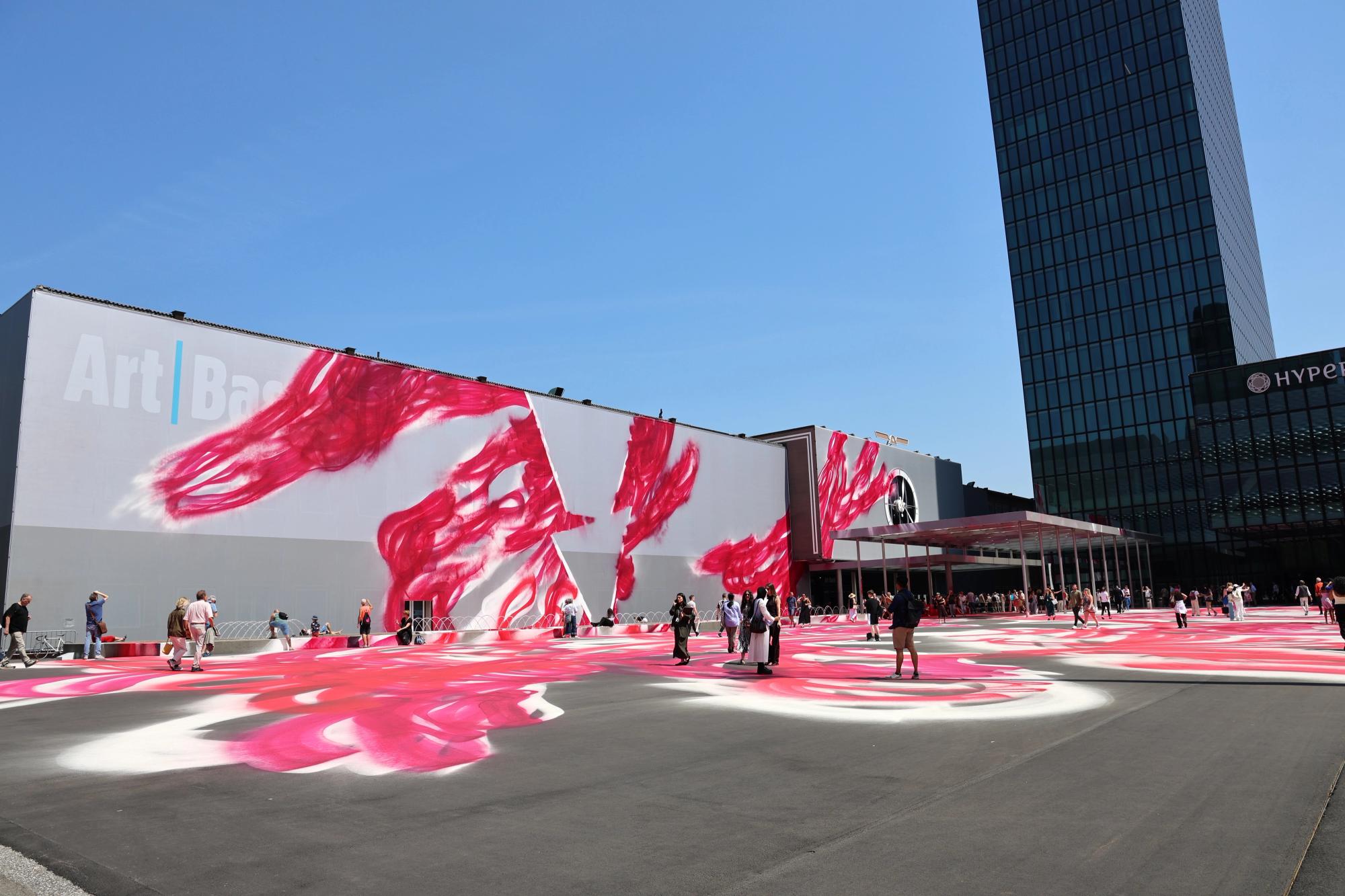
Katharina Grosse spray-painted the Messeplatz this year. The fountains, the pavement, the façade of the Hall 1 building, all of it in her characteristic overlapping swirls of pink and orange and dirty green. If you walked in from Clarastrasse the first fifty metres of the fair were her. The mood of Basel when you get off the tram is usually the mood of a Swiss-German industrial square on a hot June morning, which is to say not a mood. This year, because of Grosse, it was closer to an argument. A fair that opens with a large permanent-feeling painting on a square that is not permanent has set itself a tone.
The 56th Art Basel ran from the 19th to the 22nd of June, with preview days on the 17th and 18th. 289 galleries. Fewer first-time exhibitors than in the expansion years. A mood that was less panicked than 2024 but still careful. The interesting question in 2025 was not whether the market had recovered. It had not, not really. The interesting question was what the galleries had decided to do with a more careful mood.
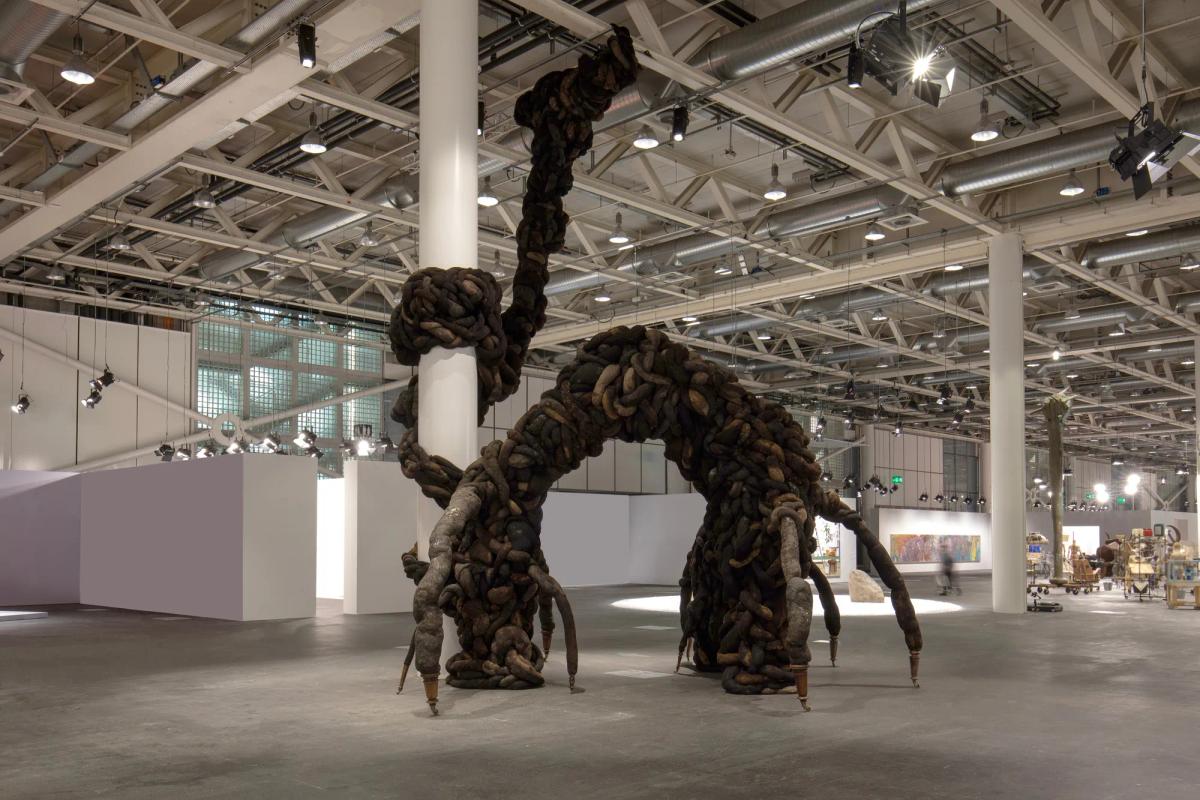
Unlimited, again curated by Giovanni Carmine, had 67 installations and a few of them were among the best the sector has produced in a decade. Nicola Turner had made Danse Macabre, a sculpture hung from the ceiling and constructed entirely from horsehair and raw wool sourced from the area around her studio in Bath. It moved with the air conditioning. It looked like a body in very slow motion. It looked like a body in very slow decay. It was obvious and it was not. Good work of this kind earns the right to its obviousness by getting the detail exact. Turner had got the detail exact.
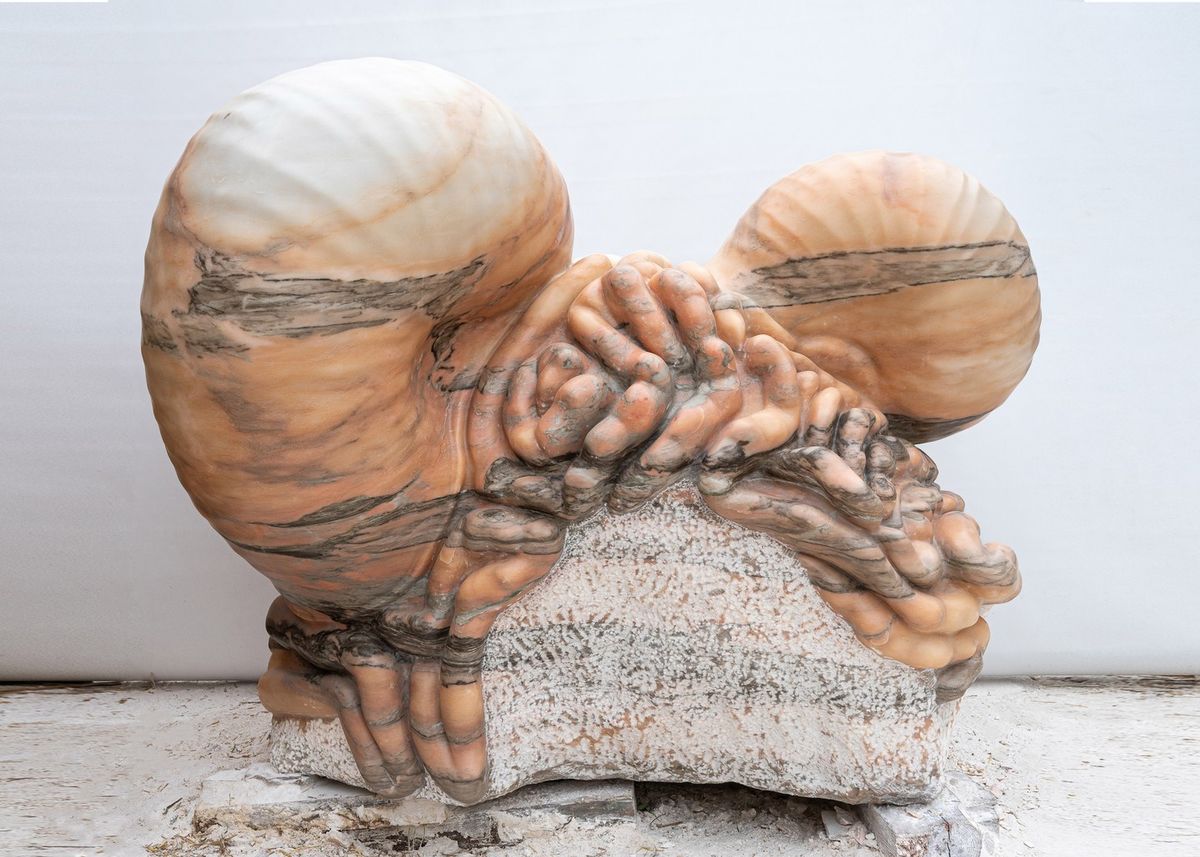
Daniel Dewar and Grégory Gicquel had installed a triptych of Rosa Aurora marble boulders, hand-carved until brains, torsos and a sewing machine emerged from the stone. The objects sat in the middle of the room like things found after a very specific earthquake. Nadira Husain had a wooden triptych of large freestanding panels on which Nefertiti was painted as a contemporary immigrant, dressed in Adidas tracksuits, doing the washing up. It was called The Haunted Museum. Su Meng-Hung, a Taiwanese artist, had arranged eight ebony lacquer screens with flowers and birds and bodies drawn from classical Chinese erotic imagery; you walked around the screens rather than past them, which changed the reading with every step. Any of these four were worth a ticket.
In the main aisles the mood was what the dealers were calling measured. A Mark Rothko on one wall at Pace. A Lucian Freud self-portrait at Acquavella. A Miriam Cahn room at Meyer Riegger that was, to my eye, the best aisle booth of the week. She had not sweetened anything. The paintings were as harsh as they have ever been. People stopped for longer in front of them than they stopped in front of the Rothko.
There was more attention on younger and mid-career galleries this year, and more of them in the first aisles rather than the back. Whether this is the fair's doing or the market's doing is an argument in itself. My read is that the market has made a small correction and the fair has been sensible enough to let it show. The glossiest booths were less glossy. The booths that had something to say were louder, proportionally.
Parcours, still under Stefanie Hessler, had pushed further into Klein-Basel this year, across the river. You walked across the Mittlere Brücke at six in the evening and a choir was singing from the top of a residential building. That was Martin Boyce. Two streets over a shop window had been replaced by a Mire Lee sculpture. A nightclub hosted a Stan Douglas film loop for one night only. Parcours, in its second year under Hessler, is becoming a real section. It was not a real section three editions ago.
At the Rhine on Saturday the ritual happened again. Linen shirts. Watertight bags. Dealers drifting downstream. A few of them, this year, admitting that the day had been quieter than they wanted. A few of them, as always, not admitting anything. Outside Hall 1 the Grosse painting was starting, very slowly, to come off under the heat. That was the point. By November most of it will be gone. This is what she wanted. A fair is a temporary thing painted onto a square. So is the square. So is the paint.