Fifty Coats of Lacquer
At Craft x Tech's Curio, traditional Japanese lacquerware met six international designers. Most of the collaborations remembered which side of the hyphen they were on.
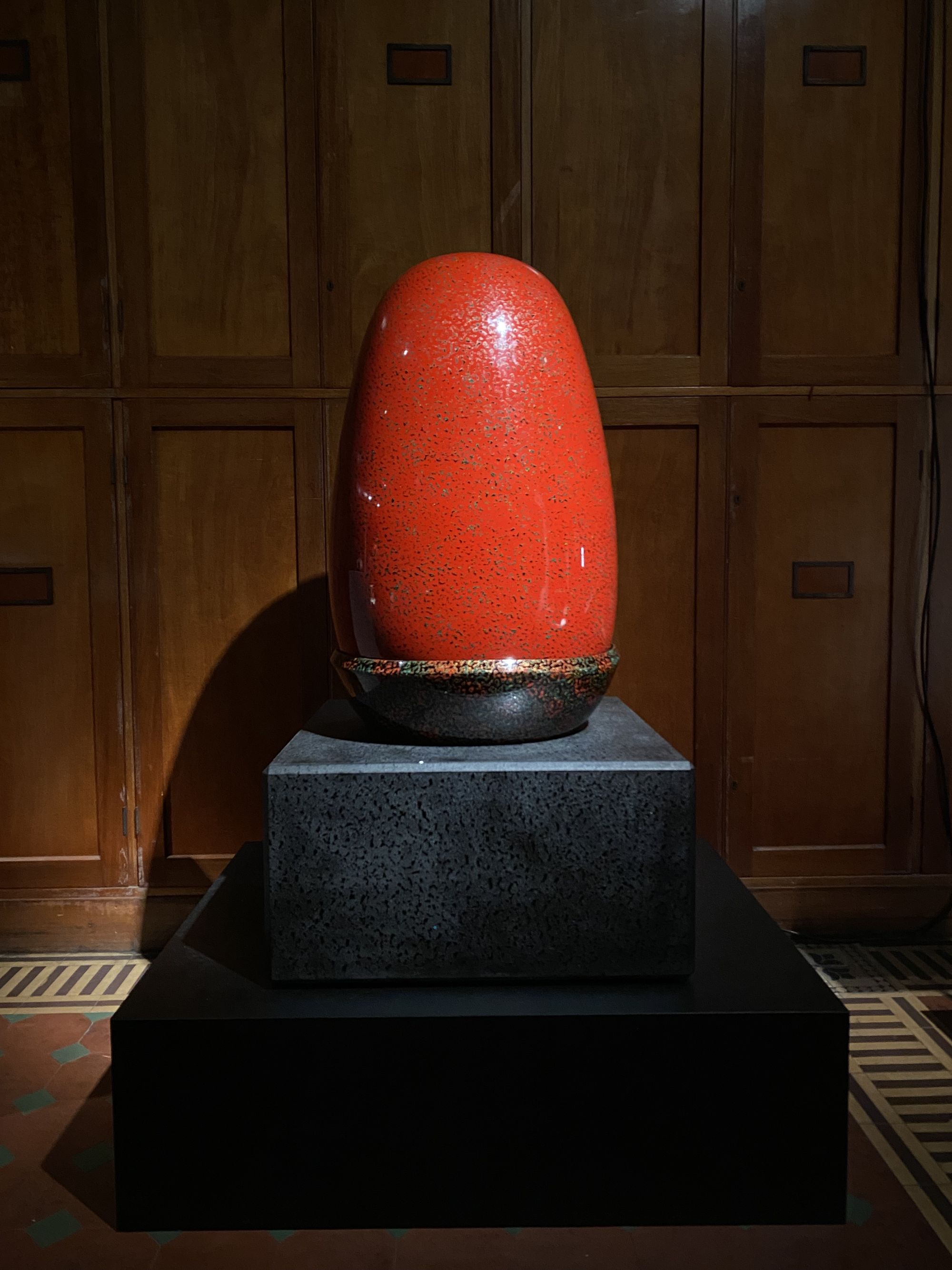
The Tokyo-based initiative Craft x Tech made its European debut at Design Miami/ Basel this year with a Curio that paired six international designers with six master artisans from Tōhoku, the northeastern region of Japan that was devastated by the 2011 earthquake and tsunami. The curator was Maria Cristina Didero. The pitch, written out, sounds a little too neat: traditional Japanese craft meets contemporary design, each side bringing the other into the present. The objects were better than the pitch.
The strongest pairing was Sabine Marcelis and the Kawatsura-shikki lacquerers of Yuzawa city in Akita prefecture. Kawatsura-shikki is a meticulous lacquering technique perfected over 800 years, famous for its durability and for the depth its layers produce. Marcelis is a Dutch designer who works with resin and light and an almost severe minimalism. On paper, she should have overwhelmed the craft. She did not. She handed over the depth to the lacquerers and kept for herself only the shape. The result was a pair of low coffee tables and a wall hanging whose surfaces read, depending on where you stood, as chocolate or as coffee or as a very dark pond. The edges were softly curved, which is not how Kawatsura-shikki usually sits: the artisans had to build a special jig to let the lacquer hold the curve. That detail, told by an artisan in a small leaflet at the booth, is the kind of thing that decides whether a collaboration has gone both ways.
Ini Archibong's contribution took a harder road. He was paired with Tsugaru-nuri, a decorative lacquerware from Aomori prefecture, and decided to use it as the body of a musical instrument. A large pod-shaped sculpture, sitting on a box of speakers, responded to hands hovering above it. You waved, more or less, and the pod sang back. The sound was deep and underwater and not quite pleasant. I watched three different people do it, and each time the effect was something between a theremin and a whale. Whether this is the right register for Tsugaru-nuri is an argument I cannot settle from one visit. But the sculpture was beautifully made, and the lacquer had not been demoted to surface. It was the body.
The other four pairings were good but leaned closer to the pitch. Studio Swine with Sendai Tansu. Michael Young with regional woodwork. Each of them interesting, none of them quite at the tension Marcelis and Archibong achieved. The risk of a project like Craft x Tech is that the artisans become the material and the designers become the author. The cases where both sides remain authors are the cases you remember.
There is a politics here, or rather a logistics. Tōhoku craftsmen have had a difficult fifteen years. The population is ageing. Apprenticeships are disappearing. Initiatives that give their techniques international visibility, and a paycheck, and a collaborator from outside, are useful. They are also easy to get wrong. The worst version of this kind of project flies a designer to Japan for three days, takes photos, orders a prototype, and pastes the artisan's name in the small print. Craft x Tech seems, on the basis of what you saw in Basel, to have done the longer version. The pieces had the particular weight that comes from decisions made more than once.
Walking out, I kept thinking about the fifty coats of lacquer. One coat a day, sometimes two. Months of work under the hands of someone who will do this for the rest of their life. The object that comes out is small. The time inside it is not. A good design fair is one where you leave with at least one reminder that time is a material. This Curio was mine.