An Eight-Metre Octopus in Front of the Eiffel
Takashi Murakami built a public sculpture for Louis Vuitton on the Champ-de-Mars for Art Basel Paris 2025. It was not subtle. It worked.
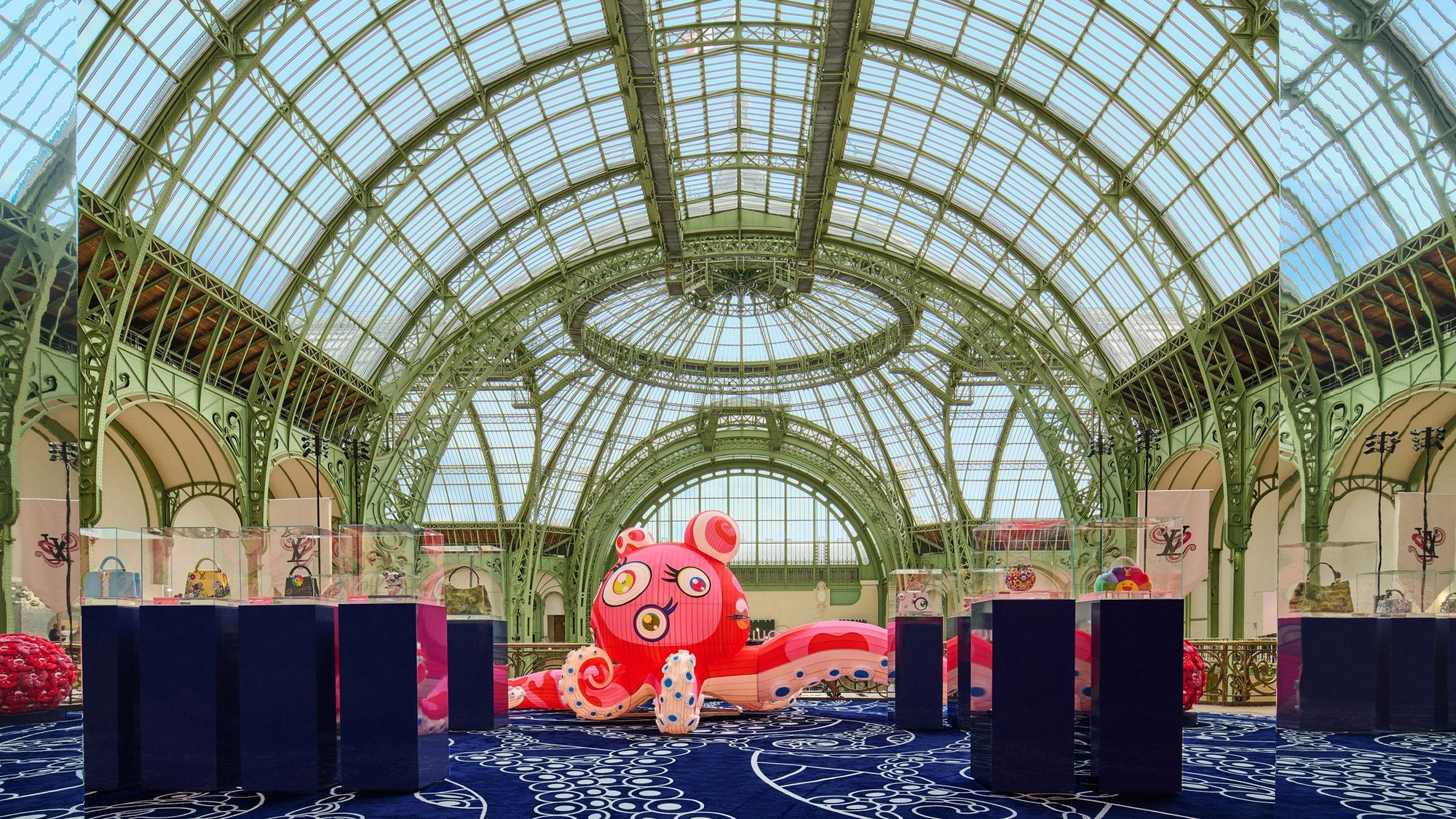
On the Wednesday of Art Basel Paris week, an eight-metre-high octopus made of moulded composite, coloured in Murakami's signature pink and turquoise and gold, was installed on the Champ-de-Mars, several hundred metres from the Tour Eiffel, for a commission by Louis Vuitton. The piece accompanied the launch of the Artycapucines VII handbag collection, Louis Vuitton's seventh round of artist-collaboration handbags, in which Murakami had treated the Capucines model as an object of his own. The sculpture stayed on the Champ-de-Mars for the three weeks around the fair. For Art Basel's public programme, it was the marquee thing.
You could either enjoy it or not. There is no arguing about a Murakami octopus in front of the Tour Eiffel. It was eight metres tall, it was pink, it was holding a very large handbag in one of its tentacles, and it was the most-photographed object in the city for the weekend. Louis Vuitton's social media team had clearly planned for this. So had the crowds. By Friday at noon a queue had formed on the grass to have a portrait taken with it. By Saturday the queue had a security rope. By Sunday there was a merchandise stand.
This is a particular register of contemporary art that has become normalised over the last twenty years, and specifically in Paris, where the Fondation Louis Vuitton and the Bourse de Commerce have between them made luxury patronage of contemporary art into a civic institution. Murakami has been at the heart of this. He has also, during those twenty years, been quietly unwell; the artist was candid in the run-up to the fair about the medical reasons for his slower recent output. That the Louis Vuitton commission was made to coincide with his return to large-scale public work was the actual news of the week, and the pink octopus was a manifesto as much as a merchandising device.
The handbags were also, in case anyone is curious, beautiful objects. Murakami had treated the Capucines shell as a sculptural surface, with some versions treated as low-relief tondi of his characteristic flower forms and others painted with the kind of fine-line manga work that is the thing he can still do better than almost anyone. The bags were limited, mostly sold before they were shown, and displayed in a side room at the Grand Palais that was constantly full. A few of them will end up, in ten years, in museum costume collections.
What to make of this as art, or as commerce, or as public sculpture, is the kind of question that anyone writing a review has been working out for two decades without resolution. My only contribution: the octopus worked. It was funny and dense and slightly sinister, and it took over its piece of the city with the particular energy of a Murakami that had something to prove. The handbags are product. The sculpture was not. That distinction still matters, even at the fair whose sponsorship model is designed to erode it.
A last small note. On Sunday afternoon, with the fair closing at six and the crowds at the octopus thinning out, a group of children from a nearby primary school were brought on a field trip to photograph the piece. Their teacher, a woman in her sixties who clearly had her own views about the art-and-commerce question, let them run at it. One child tried to climb a tentacle. Security said no, then smiled. Public sculpture in Paris has an old social role that Louis Vuitton, for all its budget, cannot quite buy. The octopus had found that role anyway. That was the generous reading. On a Sunday in October, that was the reading that felt right.