A Floor of Water
Ben Storms's "Liquid Solids" at Objects with Narratives turned a booth into a pond. The tables were in on the joke.
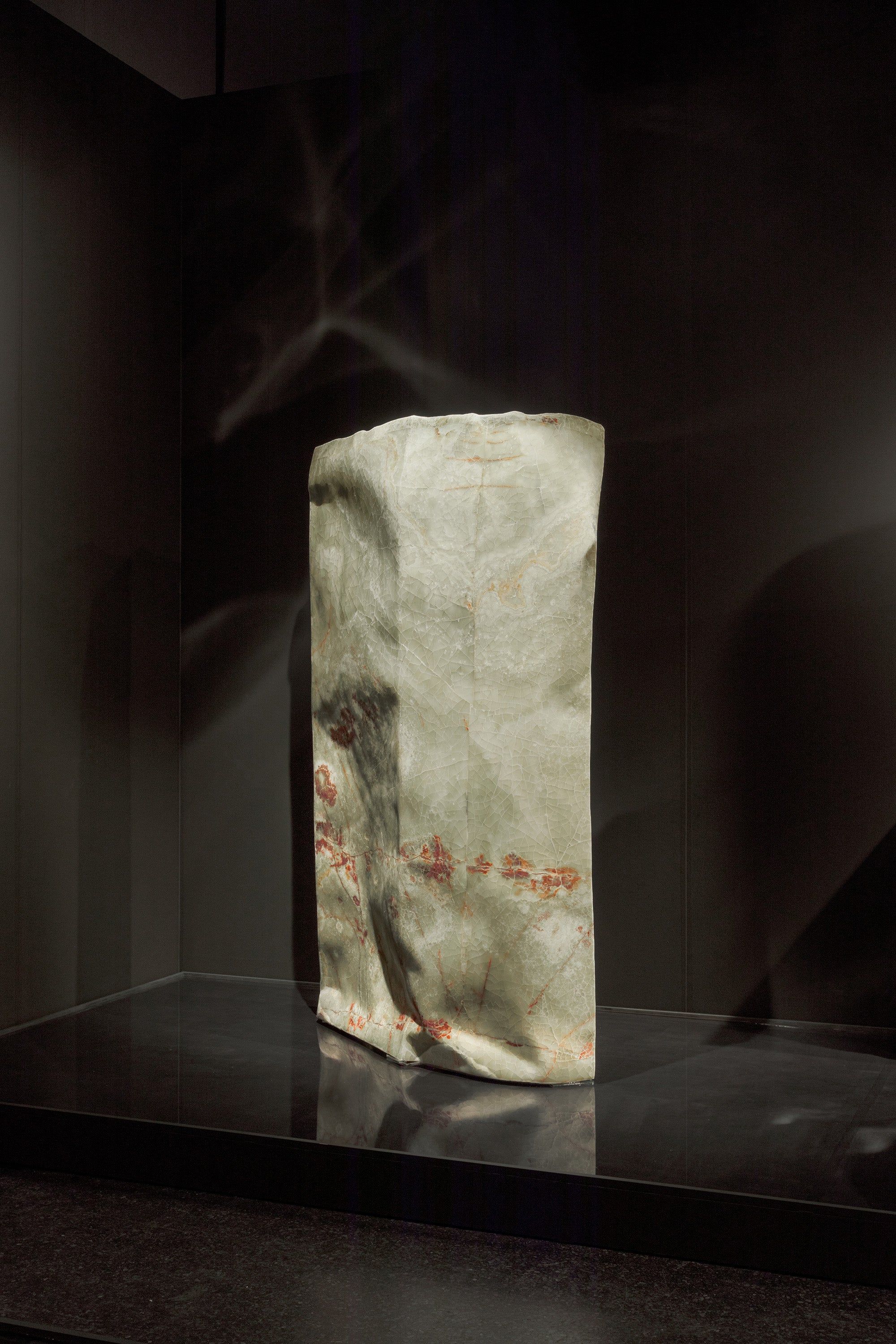
Objects with Narratives, the Brussels gallery, debuted at Design Miami/ Basel this year with a single-designer booth that took the temperature of the fair down by a few degrees. It belonged to Ben Storms, a Belgian who makes furniture out of copper and aluminium and marble and glass and who has developed a habit, over the last several years, of making hard things pretend to be soft. He called the show Liquid Solids. The floor of the booth was under a shallow layer of water. Everything seemed to be floating. Most of it wasn't.
The trick with Storms is that the trick is not one trick. A console in the middle of the booth appeared to be cast bronze, taut and full, the way a mercury drop is full. Walk around it and the logic changed. It was sheet steel. It had been inflated from inside. Storms has been doing inflated steel for a while, and the work has got sharper; the welds are better hidden, the proportions more confident. The console was functional, which is to say you could put a thing on it, but you would hesitate.
A wall piece nearby, cast in bronze, looked like a slab of wax that had been paused three seconds into pouring. A coffee table in onyx, glowing from the light below, seemed to be a pool that had frozen in a specific moment and then been sliced. A new series he called Crushed started from sheet metal welded into a shape and then compressed under force. The folds were violent. The objects ended up looking like things a glacier had done to a car.
You could take all of this as parlor-trick stuff and not be wrong. Most design-fair work deploys a thesis about materiality at some point in its wall text and most of the time the thesis outpaces the object. Storms's booth had a short wall text, and the objects did almost all the arguing themselves. A piece of glass that read as stone. A slab of stone that read as liquid. A steel console that read as if it had been blown.
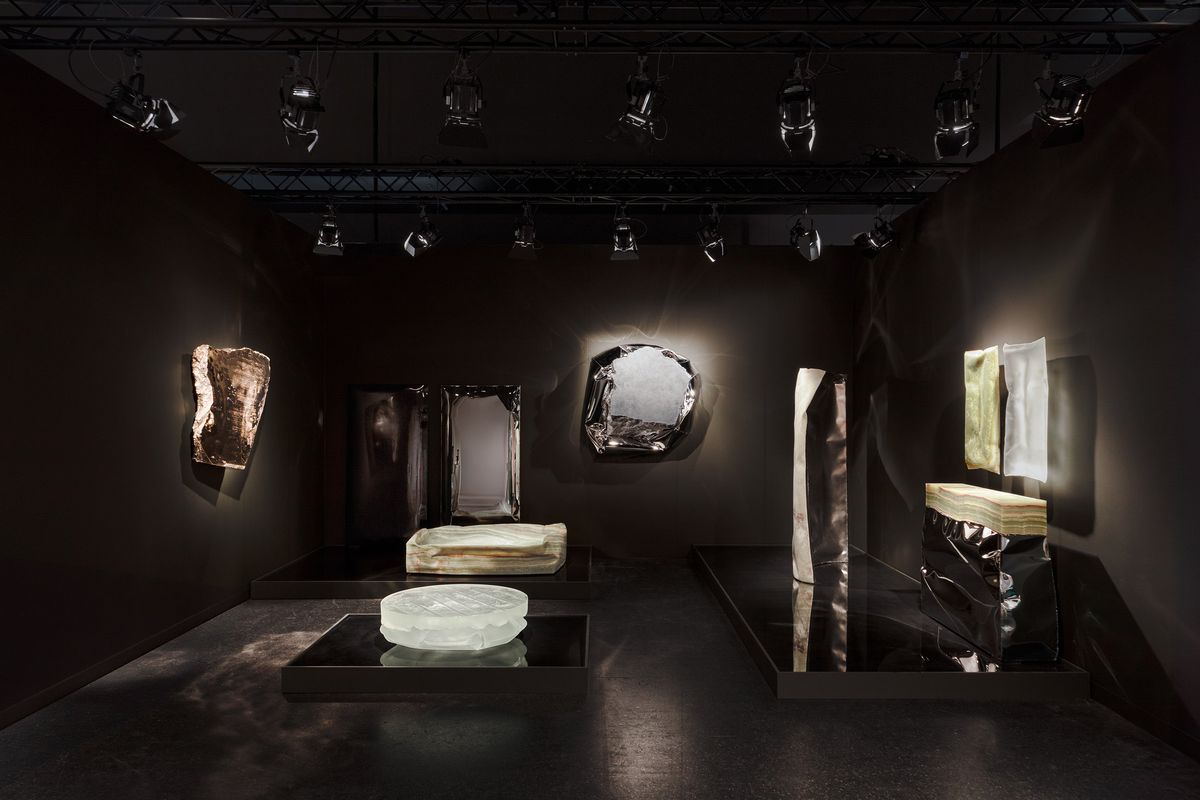
What the water on the floor was doing, I think, was giving you permission. You came in from the fair floor, which is a careful, cream-coloured, hushed place full of people not touching things, and you were asked, quite gently, to walk through a puddle in your shoes. Once you had done that you looked differently at the objects. You were more willing to knock on them, in your head, to check which assumption was correct, the eye or the hand. I did not knock. I watched a man in a suit stand in the middle of the booth for a long minute, touch the edge of a console with two fingers, flinch at its wrongness, and then grin.
That is the useful kind of design. It is not trying to be art. It is not trying to be useful in the narrow sense. It is asking you to doubt what you see and to take the doubt home with you. Storms at his best is a designer who makes furniture and lets it lie to you a little. The booth was small and the show was tight and Objects with Narratives, on its debut, found exactly the right designer for its first impression in Basel. I expect the Crushed series will move. I expect the inflated bronzes will end up in living rooms where nobody will dare put anything on them. I also expect that most of the buyers at this fair, whatever they said about it, will remember the shoes before they remember the objects. Storms would probably take that as praise.