A Biennale of Guests
Stranieri Ovunque — Foreigners Everywhere — is the organising proposition of the 2024 Venice Biennale. It is a compelling premise, and an unstable one.
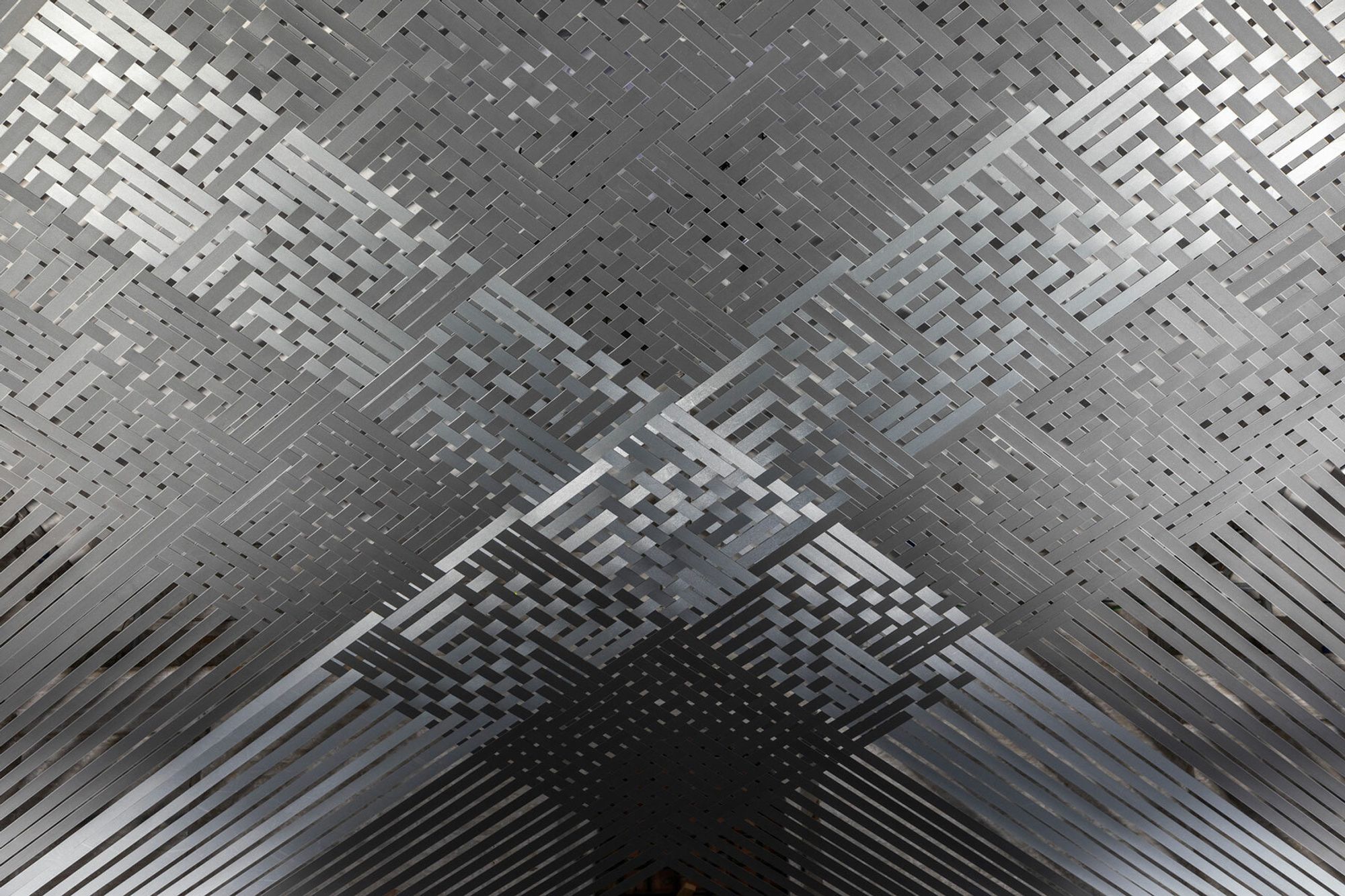
The first thing you see at the Arsenale this year is a ceiling. Two hundred square metres of neon-orange trucking strap woven into a canopy by Mataaho Collective, a group of four Māori women from Aotearoa. You walk under it and your skin goes the colour of a highway cone. The piece is called Takapau, after a Māori mat made for births and death rituals. It won one of the big Golden Lions, and you can see why within about ten seconds of standing under it. It holds the space the way a cathedral vault does, but friendlier. I saw a security guard leaning against a pillar and staring up at it with the unguarded face of someone who hadn't been told what to feel about it yet.
Adriano Pedrosa's 60th Biennale is called Stranieri Ovunque, or Foreigners Everywhere, borrowing a phrase from a Claire Fontaine neon. He is the first Latin American curator to get the job, which has been pointed out so many times that it has started to feel like a statistic the Biennale itself needs more than the artists do. The premise is that the foreigner, the outsider, the migrant, the queer, the indigenous, the self-taught, the south-of-wherever are the subjects at the centre now. There is a logic to this you can feel while walking. There are also works that survive it and works that don't.
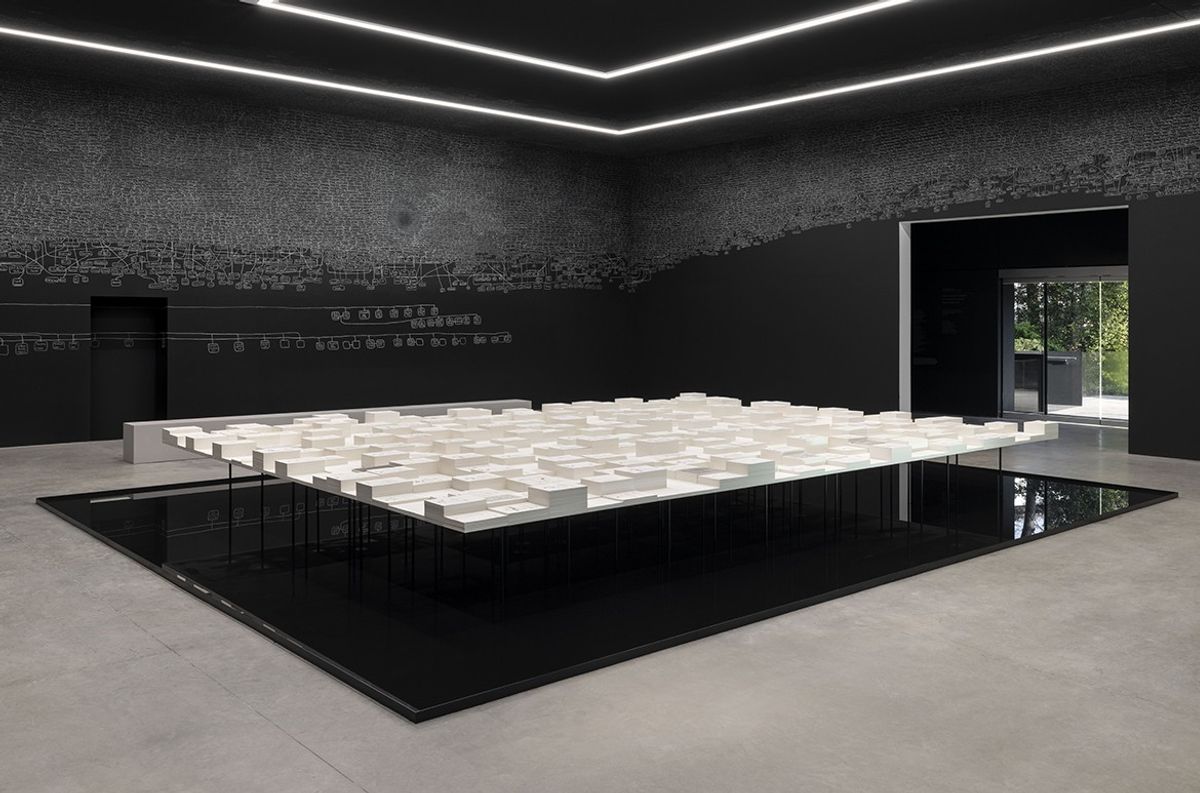
What survives: Archie Moore's Australian pavilion, a large black room with his family tree chalked onto the walls and ceiling. It goes back 65,000 years, because it tracks his Kamilaroi and Bigambul ancestry alongside his British one, and Kamilaroi genealogies do not stop at the Enlightenment. A long reflecting table in the middle holds stacks of photocopied coronial records of Aboriginal deaths in Australian custody. The room is quiet and cold and I stood in it for maybe twelve minutes before I realised other people had come and gone twice. Kith and Kin is the first Australian pavilion to win the Golden Lion. Good. It earns it by refusing to be dramatic. The chalk is handwritten. You can read it if you want.
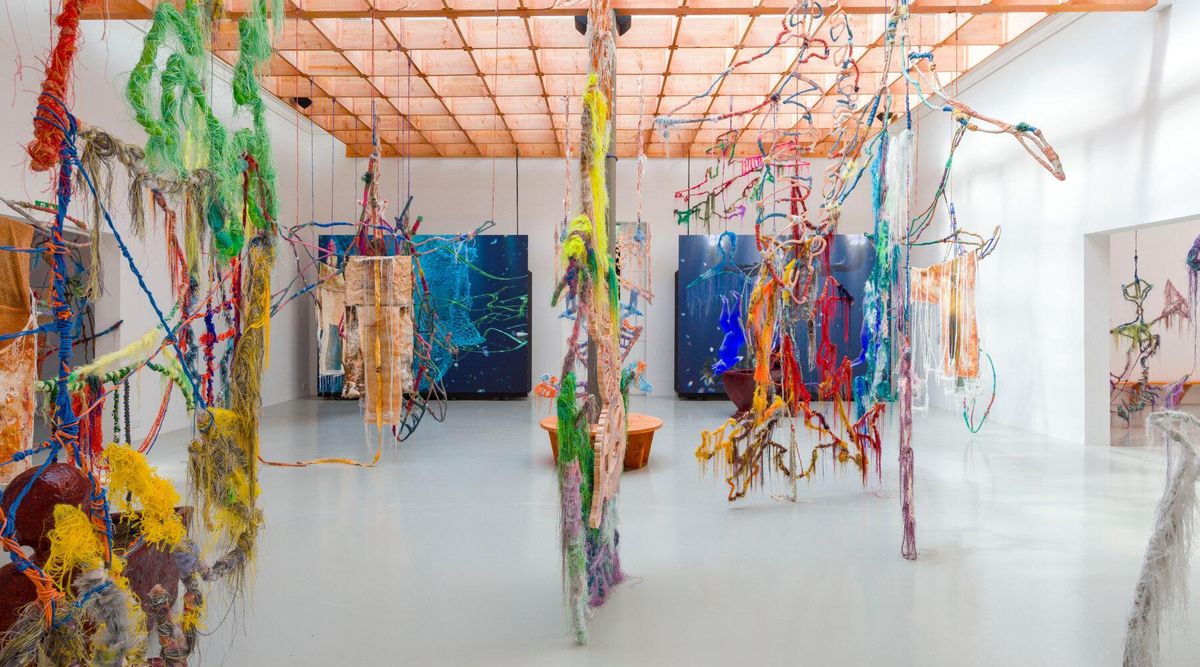
What also survives: Bouchra Khalili's Mapping Journey Project in the Arsenale, video testimony from migrants tracing their own routes onto paper maps with marker. It is from 2008, which is a quiet dig at anyone pretending this conversation started in 2024. Julien Creuzet's upside-down French pavilion, dense with dangling plastic and coral and Martinican rhythm, which manages to be a statement pavilion and an immersive installation without feeling like it is trying for either. The Nordic pavilion, given over to Lap-See Lam's Altersea Opera, with a bronze dragon's head parked at the entrance and a grid of bamboo poles inside, a Cantonese opera staged under a Swedish-Finnish-Norwegian commission, which is the kind of gesture that could have read as exotic theatre and instead reads as a corner of the world insisting the corners are where things happen.
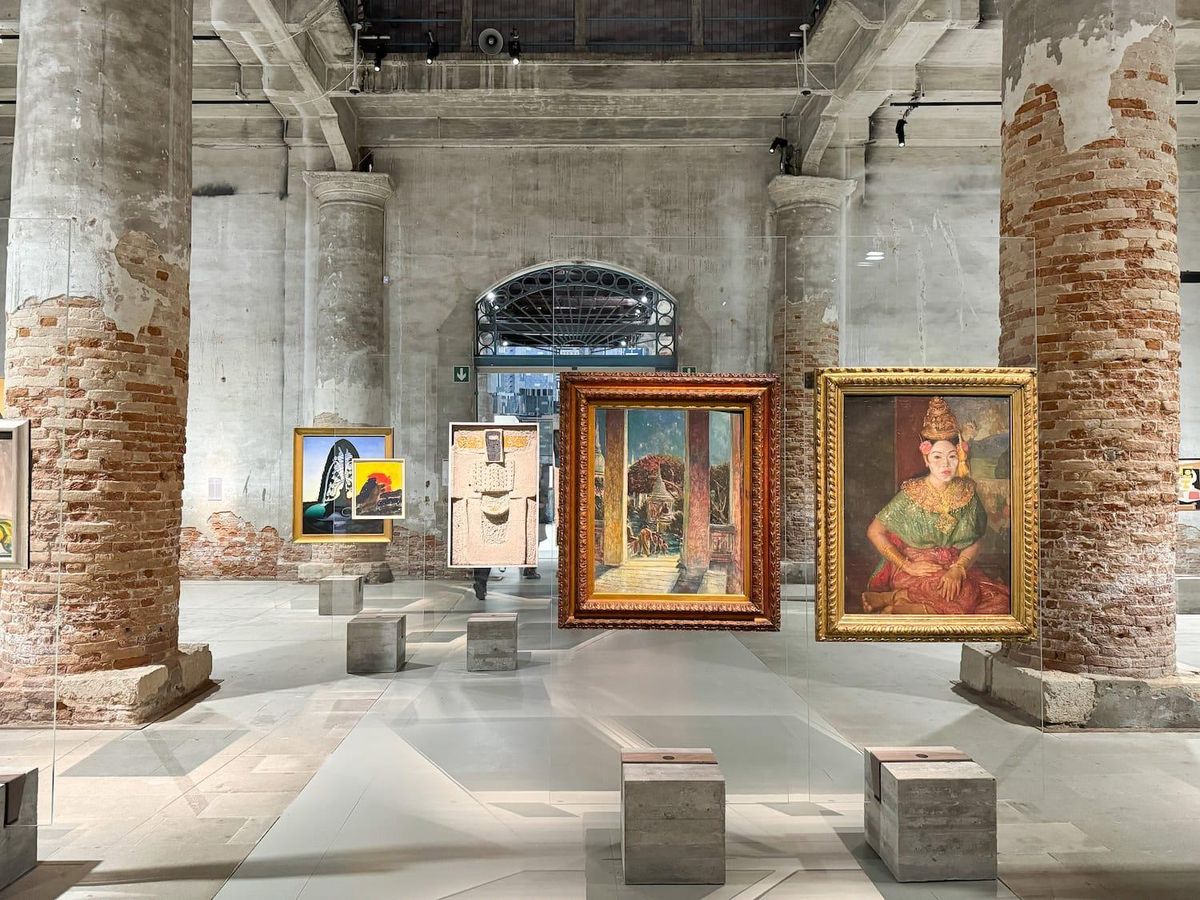
What doesn't survive: a lot of the Nucleo Storico. These are the 20th-century paintings Pedrosa has hung salon-style across two galleries, the idea being that there were modernisms happening in São Paulo and Beirut and Manila that the European canon ignored. The idea is right. The hang isn't. Canvas presses against canvas at the ankles and over the head, and the painters are not all operating at the same level. Placing a minor portrait next to a great one doesn't correct history. It just quietly suggests these are the same kind of thing, which is a bad argument to make with your eyes.
There is a larger problem, which is the problem of the show's premise itself. Foreigners Everywhere, as a title, flattens a lot of different positions. A queer artist in Singapore, a stateless person from Yemen, a self-taught painter from a village in Peru are not in the same condition, and treating them as versions of the same condition is the kind of thing that reads well in a wall text and worse once you are in front of the work. Charmaine Poh's videos of young lesbian couples in Singapore are tender and specific. Next door, a room of paintings about generic indigeneity feels like it is there to fill a thematic quota. The fault is structural. If the category is foreign, almost everything qualifies, and the curation has to work very hard to make the qualifier mean something.
Outside the main show, the pavilions are where most of the argument actually happens. The Israeli pavilion remained closed, with a statement issued by the artist Ruth Patir, a sign on the door, the guards still showing up to work. The Russian pavilion had been handed to Bolivia. The Holy See was tucked inside a women's prison on Giudecca. You took a boat over and queued and the inmates were your guides through a group show of several artists, Cattelan's bare feet painted across the chapel façade, Claire Fontaine's neon in the corridor, Corita Kent and Claire Tabouret and four others around the prison grounds. That pavilion did more, in my view, than most of the Giardini combined. It wasn't trying to be universal. It was trying to be in a particular place with particular people, and the universality came afterwards, if at all.
I wanted to like the Nucleo Storico more than I did, because its problem is not only formal but structural. Modernism did happen outside Paris and New York. The canon is shallower and more provincial than it admits. But you do not fix a provincial canon by rushing through five decades of parallel histories in two hot rooms. You fix it slowly, show by show, with enough space around each painting for it to be itself.
Stranieri Ovunque is an uneven Biennale, but also an expansive and generous one. The most compelling rooms are the ones where representation gives way to specificity, where the work is allowed to speak from a precise position rather than stand in for a broader category. Moore’s chalk. Mataaho’s ceiling. Khalili’s marker on a paper map. A woman on Giudecca telling you what she made of Cattelan. These stay. The rest shifts and rearranges itself as you move through the Giardini and back onto the vaporetto, less a set of conclusions than a field of impressions that continues to unfold afterwards.